


If you've ever opened a lab report, seen urea nitrogen blood flagged, and thought, “Is this a kidney problem or just a weird one-off?”, you're asking the right question.
A single BUN result often creates more anxiety than clarity. The number looks precise, but by itself it can be noisy. Hydration, recent protein intake, and what your creatinine is doing at the same time often matter more than the isolated flagWhile BUN by itself can be helpful, its true utility comes from combining it with other biomarkers.
Goodlabs is a health platform that gives blood donors free clinical-grade lab panels (run at Quest or Labcorp), and offers the same panels at low cost to anyone who doesn't want to donate.
Table of Contents
That One Lab Result You Can't Make Sense Of
A flagged BUN result is a perfect example. It shows up on a panel, looks important, and rarely comes with enough explanation to tell you whether it reflects kidney stress, dehydration, yesterday's steak dinner, or something else entirely.
That's the gap. Modern testing gives you numbers fast, but not always the context to read the story behind them. If your BUN came from a Comprehensive Metabolic Panel, it was likely placed next to several other markers for a reason. It's meant to be read as part of a pattern, not as a standalone warning light.
Practical rule: A BUN result is less like a diagnosis and more like a clue.
The clients who get the most value from this marker aren't the ones who memorize “high” and “low.” They're the ones who ask better questions. Was I dehydrated? Have I been eating more protein than usual? What did creatinine look like? Has this changed over time, or is it a single blip?
That shift matters. Once you stop treating BUN as a kidney-only score, the result becomes much easier to interpret intelligently.
What Is Blood Urea Nitrogen and How Is It Made
Blood urea nitrogen, usually shortened to BUN, measures how much urea nitrogen is circulating in your blood. Urea is a waste product your body makes after breaking down protein. The liver handles the conversion work, and the kidneys remove that waste into urine.
Think of BUN like waste leaving a factory
A simple way to understand it is to picture your body as a factory line. Food brings in raw material. Protein gets broken down into amino acids. That process creates nitrogen waste that can't just sit around. The liver converts it into urea, which is safer to transport, and the kidneys act like the cleanup department that filters it out.
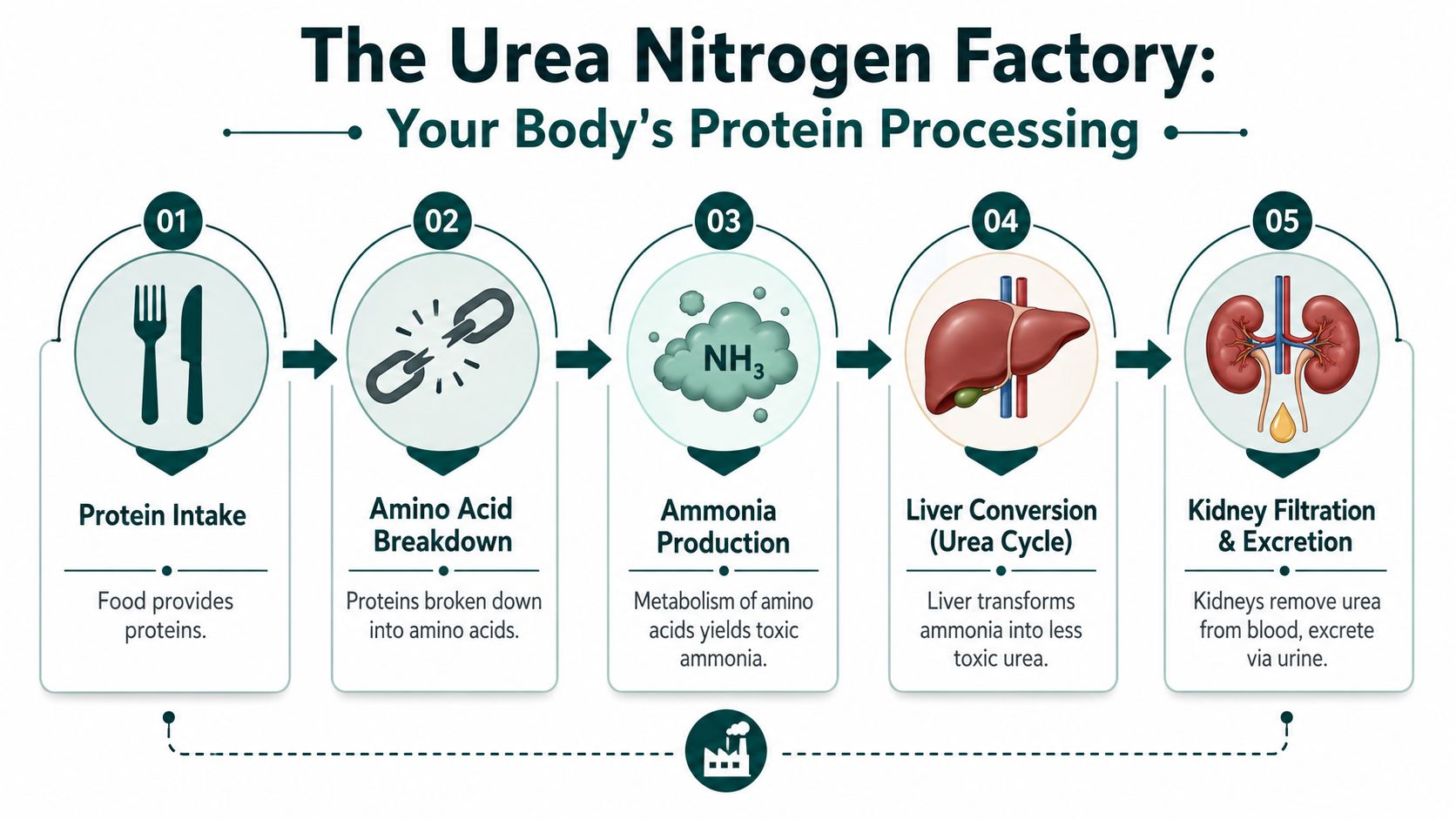
This is why BUN can reflect more than one organ system. It touches protein metabolism, liver processing, blood concentration, and kidney filtration. If you want a broader look at how these systems interact, this overview of liver and kidney blood tests is a useful companion.
How the lab actually measures it
On major chemistry systems, BUN is measured with an enzymatic conductivity rate method. Urease converts urea, and the analyzer measures the rate of increase in solution conductivity, which is directly proportional to urea concentration. The CDC method documentation lists a typical reportable range of 1–150 mg/dL on the referenced platform, showing this is a wide-range quantitative assay, not a simple yes-or-no screen (CDC laboratory methods documentation).
That technical detail matters for one reason. The number is real and standardized. The challenge isn't whether the lab measured it well. The challenge is whether you're interpreting it with enough context.
Understanding Normal BUN Levels
The usual adult reference range for urea nitrogen blood results is around 6–24 mg/dL. Cleveland Clinic also lists more specific ranges of 8–24 mg/dL for adult males and 6–21 mg/dL for adult females (Cleveland Clinic BUN test reference).
Reference range is a starting point
That range gives you a frame, not a final answer. A result inside range doesn't automatically mean everything is ideal for your situation. A result outside range doesn't automatically mean disease. Reference intervals are built to guide interpretation, and labs can vary in how they present them.
A smart reading of BUN starts with two questions:
Was the result barely outside range or clearly unusual
Does it fit with the rest of the panel and your recent habits
Normal doesn't always answer the practical question
For proactive clients, “normal” is often less helpful than “consistent.” If your BUN usually sits in one part of the range and suddenly shifts, that trend may matter more than whether the lab printed a flag. That's especially true if you've changed hydration, training load, or protein intake.
If you want a better lens for that distinction, this piece on optimal vs normal blood test ranges helps clarify why lab reference ranges and personal baselines aren't the same thing.
A reference range tells you where many people fall. It doesn't automatically tell you why you landed there.
That's why the next step isn't guessing. It's looking at what else could be moving the number.
Why an Isolated BUN Reading Can Be Misleading
A lot of people see a high BUN and jump straight to kidney fear. That shortcut causes unnecessary panic. An abnormal BUN can reflect dehydration, high-protein intake, gastrointestinal bleeding, heart failure, or liver disease, which is why clinical sources stress that it should be interpreted with other tests such as creatinine rather than alone (MedlinePlus on BUN testing).
Why high doesn't automatically mean kidney disease
Here's the practical reality. BUN rises when your body is making more urea, when your blood is more concentrated, or when your kidneys aren't clearing waste efficiently. Those are different situations, and they don't point to the same conclusion.
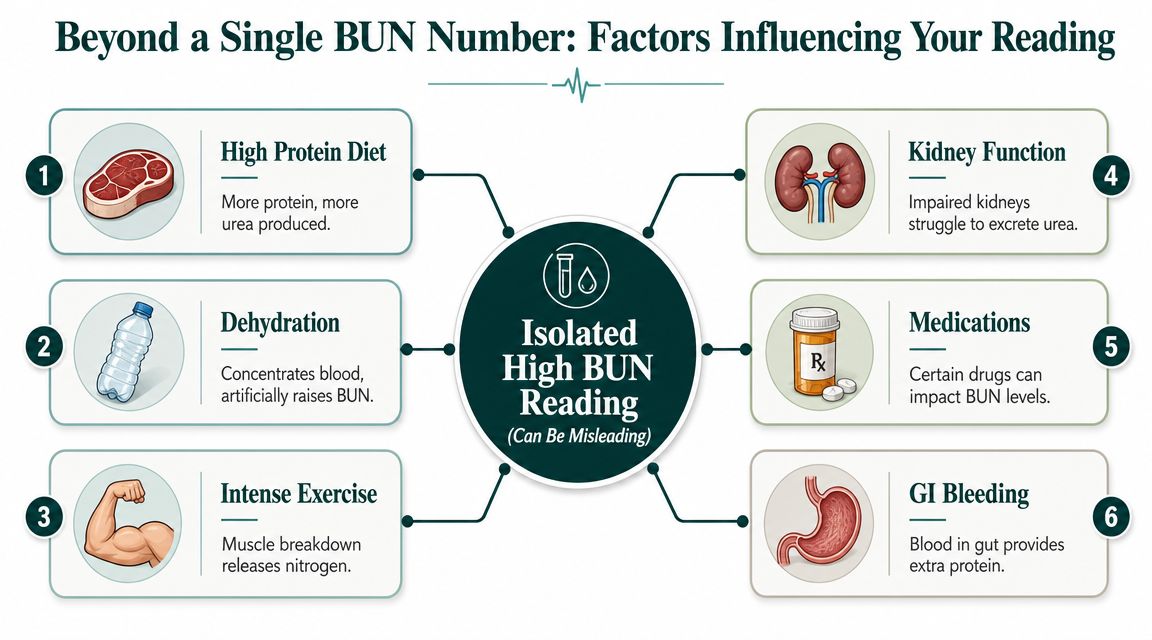
Common real-world reasons a result can look high include:
Dehydration: Less fluid in circulation can concentrate blood markers.
Higher protein intake: More protein breakdown can mean more urea production.
Medication effects: Some drugs can shift lab values.
Urinary obstruction or circulation issues: These can change how waste is cleared.
GI bleeding: Digested blood adds a protein load that can push BUN upward.
For active people, one more issue shows up often. They test after hard training, after a sauna, after travel, or after underhydrating on purpose for body composition reasons. That makes interpretation harder if you don't know the setup behind the draw.
What a low result can mean
Lower BUN doesn't always mean “better.” It can appear with overhydration or liver-related issues, and age can also affect how results are viewed clinically. The point isn't to overread every low value. It's to avoid reading low as universally protective and high as universally dangerous.
Treat BUN like a traffic signal in bad weather. You still need the rest of the road conditions to know what's actually happening.
The BUN to Creatinine Ratio The Real Story
If BUN alone is a clue, the BUN-to-creatinine ratio is often where the interpretation becomes useful. UMass Memorial notes that the ratio may be more informative than BUN alone, especially for athletes and health-focused people, because a single BUN result can mislead without context from hydration, protein intake, and paired biomarkers (UMass Memorial blood urea nitrogen overview).

Why pairing markers changes the interpretation
Creatinine is often a steadier companion marker when you're trying to understand kidney-related patterns. Looking at BUN beside creatinine helps separate “maybe I was dry and overdid protein” from “this needs a closer clinical look.”
A practical way to consider this:
Pattern | More likely interpretation |
|---|---|
Higher BUN with more stable creatinine | Hydration status, protein intake, or other non-kidney context may be influencing the result |
Higher BUN with higher creatinine | The pattern deserves a more careful review with a physician |
One unusual BUN after a lifestyle change | Retesting under more consistent conditions may be more useful than reacting immediately |
That's also where broader kidney markers can add perspective. If you're looking beyond standard chemistry markers, Cystatin C testing can be part of a more complete discussion with your physician.
A practical way to read the pattern
Before you assign meaning to a ratio, ask what happened in the previous day or two. Did you train hard? Eat a lot more protein? Travel? Sweat heavily? Skimp on fluids before the blood draw? Those details often explain more than people expect.
This short video gives a helpful visual overview of how kidney-related markers fit together:
The key trade-off is simple. An isolated BUN is easy to get but easy to misread. A paired interpretation takes a little more thought, but it's usually far more useful.
How to Test and Track Your BUN Levels
BUN is a routine lab analyte, and it's commonly included in a standard metabolic panel. Mayo Clinic notes that it can help uncover kidney problems early, and that reporting typically uses mg/dL in the U.S. and mmol/L internationally (Mayo Clinic BUN test overview).
Where BUN usually shows up
BUN isn't typically ordered in isolation. It usually appears inside broader blood work, which is useful because context is built into the panel. You can review it beside creatinine and the rest of your chemistry markers rather than trying to guess from one number alone.
If you like understanding how lab results are standardized behind the scenes, the OMOPHub LOINC API documentation is a useful reference for how test identifiers are organized across systems.
Why tracking beats reacting
One result can be distorted by a weird week. A series of results is harder to fool. That's why I encourage clients to test under similar conditions when possible. Similar hydration. Similar training load. Similar diet pattern before the draw. Then compare trends, not just flags.
If you're ready to get your labs in order, you can book blood tests online and review BUN in the context it needs.
Your Action Plan Interpreting and Managing Your Results
A mildly abnormal BUN shouldn't trigger panic. It should trigger better questions.
Start with context before panic
Run through the basics first:
Hydration: Were you underhydrated before the draw?
Diet: Did you eat noticeably more protein than usual?
Timing: Was the blood test taken after intense exercise, travel, or poor sleep?
Companion markers: What did creatinine and the rest of the panel show?
If the pattern still looks off, bring the full set of results to your physician. That leads to a much better conversation than focusing on one flagged line item.
Build a record you can actually use
Tracking over time is what turns BUN from noise into signal. Keep copies of your labs, note any major lifestyle changes around test dates, and organize them in one place. If you need a simple system, this guide to organizing medical records for your family is practical and effective.
The goal isn't to chase a perfect number. It's to understand your pattern well enough to make smarter decisions.
Blood test results are informational and not a medical diagnosis. Talk to your physician about what your results mean for you.
FAQs Urea Nitrogen Blood (2026)
Is a high urea nitrogen blood result always a kidney problem?
No. A high BUN can also reflect dehydration, higher protein intake, gastrointestinal bleeding, heart failure, liver disease, or urinary obstruction.
What's a normal range for BUN?
Typical adult reference ranges are around 6–24 mg/dL, with some labs listing 8–24 mg/dL for adult males and 6–21 mg/dL for adult females.
Why is the BUN-to-creatinine ratio important?
It adds context. BUN alone can mislead, while the ratio can help clarify whether hydration, diet, or a kidney-related issue may be influencing the result.
Is BUN usually tested by itself? Usually not. BUN is commonly included in broader blood work such as a metabolic panel, which makes interpretation more useful.
If you want affordable, clinical-grade blood testing with clearer follow-through, Goodlabs makes it simple. You can get free lab panels with a qualifying blood donation, or order tests directly at low cost without a subscription.

Jake Kaiser
jakesjourney.co