
General Wellness and Longevity
Employee Wellness Program Benefits: Boost ROI

Jake Kaiser
jakesjourney.co
Employee Wellness Program Benefits: Boost ROI
Most advice about employee wellness still starts in the wrong place. It starts with perks, participation, and visible activity. Leadership approves step challenges, meditation apps, screenings, and incentives, then waits for lower claims, stronger productivity, and better retention to appear.
That logic sounds reasonable. It's also incomplete.
The strongest business case for employee wellness program benefits doesn't come from proving that employees clicked, joined, or attended. It comes from proving that a program changed health behavior in a way the business can measure, and from being honest about where the evidence is strong, where it's mixed, and where leaders usually overclaim. That matters because executives don't fund intentions. They fund repeatable outcomes, lower risk, and clearer accountability.
The most useful way to think about wellness today is this. A program is not a perk portfolio. It's a health-risk management system for a workforce. If it's designed well, it can support employees earlier, reduce friction around preventive action, and create a more credible path to long-term ROI. If it's designed poorly, it becomes another underused benefit with attractive participation slides and no real decision value.
Angle: The primary value of employee wellness isn't participation. It's whether a program produces measurable health insight that leadership can connect to business outcomes.
Thesis: Employee wellness program benefits are most defensible when employers stop treating wellness as an engagement campaign and start measuring clinical relevance, trust, and behavior change with the same rigor they apply to any other investment.
Beyond Perks The Business Case for Wellness
Calling wellness a soft benefit ignores how established it already is. Workplace programs date back at least to 1979, when Johnson & Johnson launched its Live for Life initiative. By 2019, the Kaiser Family Foundation reported that 84% of large employers offered a wellness program, covering an estimated 63 million employees. That history matters because it shows wellness didn't survive as a fad. It matured into standard benefits infrastructure at scale, as summarized in this workplace wellness adoption snapshot.
What changed over that period wasn't just availability. The expectation changed. Earlier programs often centered on general health promotion. Today, leadership teams expect employee wellness program benefits to show up in risk management, claims strategy, productivity, and recruiting narratives.
That's where many programs lose credibility. They're still marketed internally as feel-good support, while being sold to executives as a financial lever. Those are not the same promise.
Wellness becomes strategic when it changes decisions
A strategic wellness program does three things well:
Identifies preventable risk earlier: It helps employees spot issues worth discussing with a physician before they become more complex and expensive.
Reduces friction around action: It makes the healthy choice easier to start, not just easier to talk about.
Produces evidence leadership can use: It gives HR and finance more than anecdotes when budget season arrives.
Practical rule: If a wellness initiative can't tell you what risk it addresses, what behavior it's trying to influence, and how success will be measured, it's a perk, not a strategy.
The strongest business case usually doesn't begin with yoga stipends or challenge participation. It begins with whether the employer has created a system that helps people understand their health status and act on it early. That's why preventive data matters so much in the modern conversation around regular blood testing benefits. Without objective insight, wellness often turns into branding.
Leadership should also separate two goals that are often bundled together. One is improving the employee experience. The other is improving workforce health risk. Both matter. But only the second one creates a durable ROI argument.
The Five Pillars of Wellness Program ROI
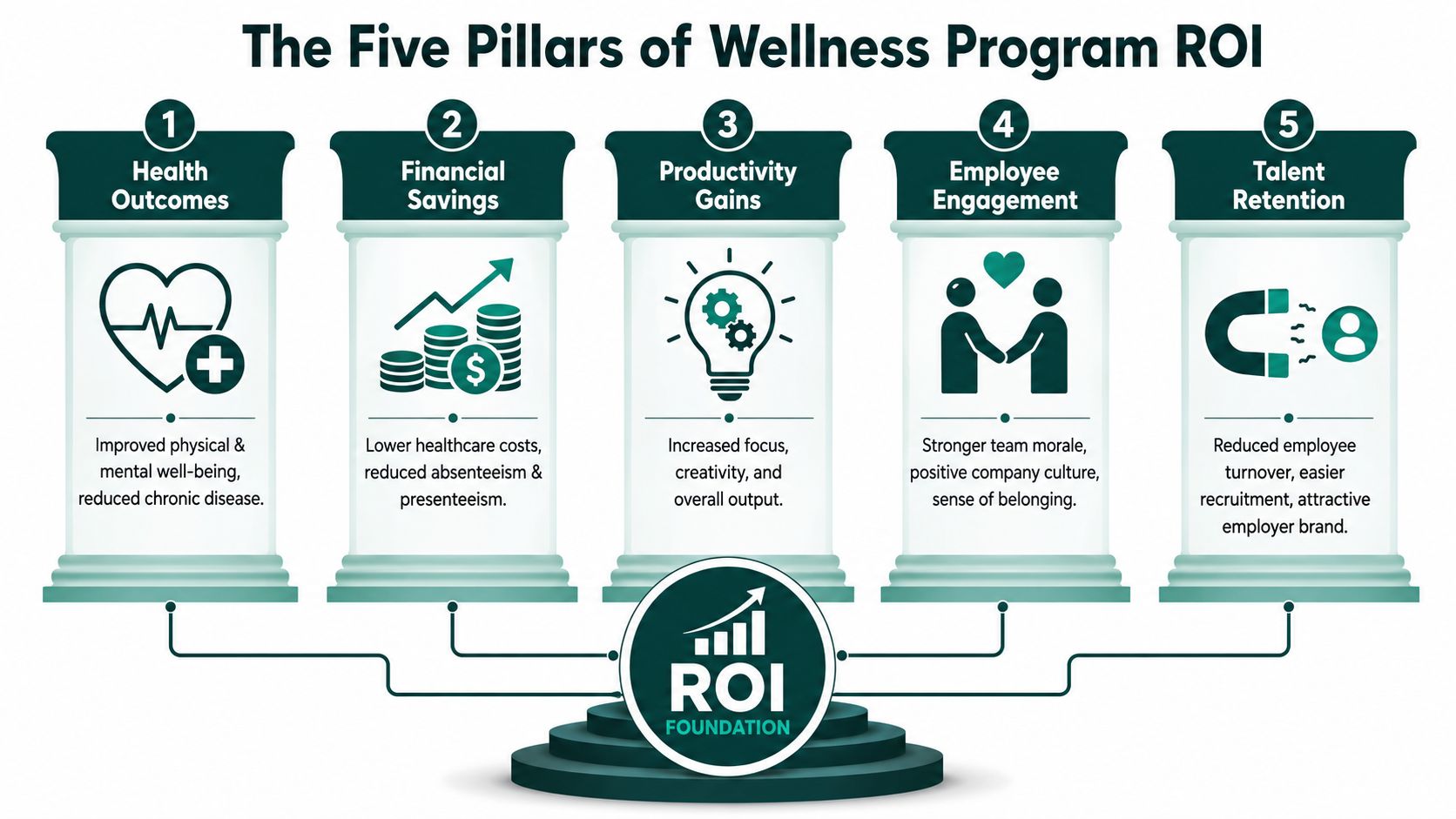
ROI in employee wellness is easier to defend when leaders stop looking for a single headline number. Returns show up through different channels, on different timelines, and with different levels of confidence. A stronger framework is to evaluate five pillars together: health outcomes, financial savings, productivity, engagement, and retention.
Why health is still the base layer
Health is the foundation because the other four pillars depend on risk changing in the right direction. If blood sugar, lipids, blood pressure, sleep, and weight-related risk stay flat, later claims savings and productivity improvements are harder to attribute and harder to sustain.
Published estimates often cited in this category show meaningful upside. A widely referenced review found roughly $3.27 in lower medical costs and $2.73 in lower absenteeism costs for every $1 spent on wellness, as noted earlier. A separate Department of Labor wellness services report highlighted long-range cardiovascular benefits under full participation, including fewer fatal and nonfatal events over time.
Leadership should read those figures carefully. They are directional evidence, not a promise that every employer will get the same return. The stronger conclusion is narrower and more useful. Preventable cardiometabolic risk carries financial consequences, and earlier identification gives employers a better chance to reduce them before they become expensive claims.
That is why programs anchored in objective preventive data tend to create a clearer business case than programs built around incentives alone. Employers that use screening and lab-based insight can target follow-up support where risk is concentrated, measure change over time, and show whether the program is influencing markers tied to future cost. That makes a focus on metabolic health markers and risk trends far more valuable than treating wellness as a steps challenge with gift cards.
What finance and productivity leaders should care about
Financial savings and productivity should be tracked separately because they answer different executive questions. Finance wants to know whether avoidable cost pressure is changing. Operating leaders want to know whether employees have the energy and consistency to perform well.
Here is a clearer way to frame the five pillars for leadership review:
Pillar | What leadership should watch | Why it matters |
|---|---|---|
Health outcomes | Biometric risk trends, screening follow-through, movement in high-risk groups | This is the earliest proof that the program is affecting the right problem |
Financial savings | Medical spend direction, avoidable risk concentration, absenteeism-related cost pressure | This is the most direct route to CFO attention |
Productivity gains | Energy, consistency, capacity, fewer health-related work disruptions | Operational performance improves when health issues interfere less with work |
Engagement | Trust, perceived usefulness, repeat participation in relevant services | Employees use programs they believe will help them without exposing private data |
Retention | Retention patterns in key groups, employee sentiment, benefit-value perception | Wellness can support retention, especially when employees see tangible personal value |
Behavior change belongs in this conversation because it sits between activity and outcomes. RAND researchers found employees at worksites with wellness programs were more likely to report regular exercise and active weight management in this review of workplace wellness evidence. That does not close the ROI case on its own, but it helps explain why participation is an incomplete metric. The more important question is whether participation leads to measurable movement in risk factors that matter.
Retention and culture are real, but they need evidence
Engagement and retention can strengthen the business case, but they should be presented with restraint. Leaders hear broad claims about culture every budget cycle. Wellness earns credibility when HR connects employee sentiment to operational evidence rather than relying on good intentions.
A disciplined approach helps:
Use retention as a supporting benefit, not the primary justification
Connect engagement claims to program usefulness, trust, and repeat usage
Separate privacy-safe aggregated reporting from any employee-level health information
Show whether higher-risk employees are getting earlier care, not just whether more people joined a challenge
Privacy matters here. Employees are more likely to participate when the employer can explain what data is collected, who sees it, and how reporting is aggregated. That trust issue is not secondary to ROI. It affects whether the program produces enough valid data to prove value in the first place.
The strongest wellness strategy works as a portfolio. Clinical insight identifies risk. Financial measures show whether that risk is becoming less expensive. Productivity data shows whether health improvements are helping people perform. Engagement and retention show whether the program is credible enough to keep working over time.
Why Most Wellness Programs Fail to Deliver
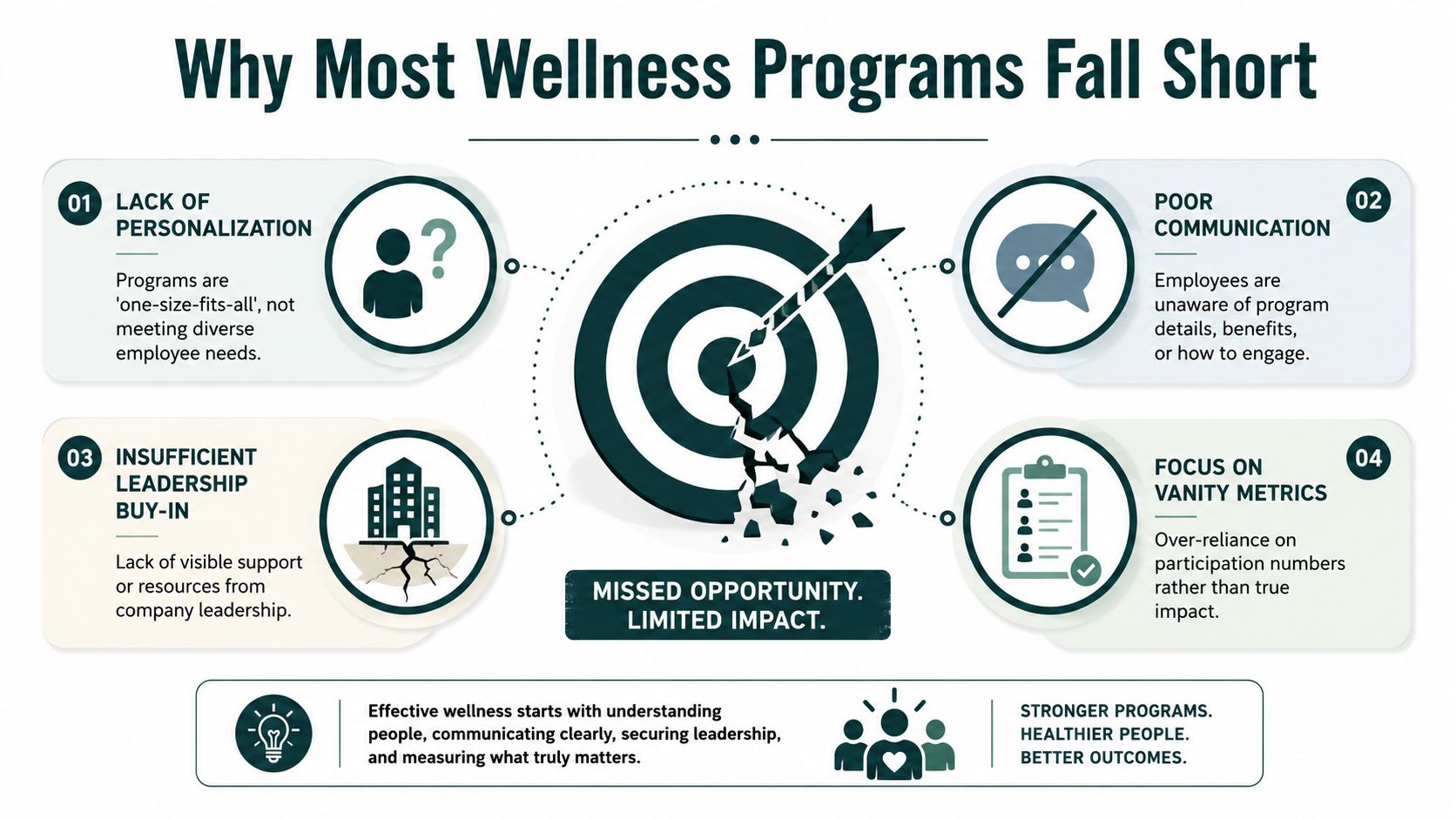
Many wellness programs don't fail because employees are indifferent. They fail because the program asks for trust, time, and behavior change without earning any of the three.
That distinction matters. It shifts responsibility from employee motivation to program design.
Employees usually aren't rejecting health
The most common reasons employees skip wellness programs are practical and trust-based. EBRI-reported reasons included lacking time (56%), not knowing enough about the program (43%), and worrying their employer will access personal health information (33%), as summarized in this report on why employees opt out of wellness offerings.
That should change how leaders interpret low uptake.
Employees may be saying:
This doesn't fit my schedule
I don't understand what I'd get from it
I don't trust where my data goes
I'd rather manage this privately on my own
None of those responses means wellness lacks value. They mean the program failed to make value obvious and privacy credible.
Privacy isn't a side issue in workforce health. For many employees, it's the entry requirement.
A surprising number of employer programs still act as if incentives alone will overcome these objections. They won't. Incentives can increase initial attention, but they don't resolve uncertainty about relevance or confidentiality.
Participation is the easiest metric and the weakest argument
The second reason programs disappoint is measurement failure. Leaders often celebrate sign-ups because sign-ups are visible, fast, and easy to report. But participation counts can create false confidence.
A program can generate enrollments and still underperform where it matters. That's why wellness dashboards need to distinguish exposure from impact. If an employee logs in once, completes a challenge, or redeems an incentive, that's activity. It isn't evidence of reduced risk.
A useful test is whether the current measurement model would survive a finance review. If the dashboard mostly shows registrations, event attendance, and portal clicks, leadership doesn't have an ROI case. It has an engagement report.
Before expanding budget, employers should pressure-test assumptions with a simple benefits planning calculator mindset: what costs are the program meant to influence, over what time horizon, and with what evidence standard? That exercise often reveals the underlying issue. The program wasn't underused because employees failed. It was underdesigned because the employer measured the wrong things.
Designing a Program Employees Actually Use
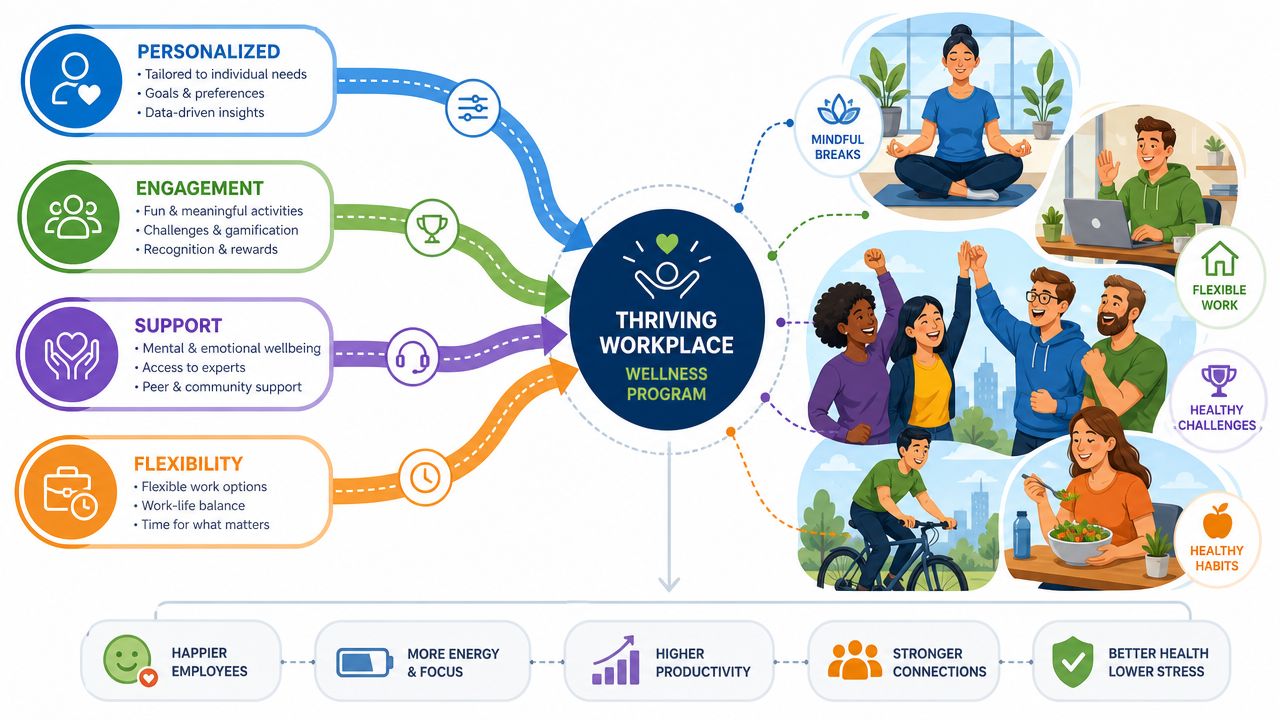
Program design should solve for human friction first. If employees have to sacrifice privacy, convenience, or relevance to participate, uptake will remain uneven and outcomes will remain hard to prove.
A modern wellness strategy works better when it behaves less like a campaign and more like a service.
Start with trust before incentives
Most employers build the incentive structure first. That's backwards.
Employees need clear answers to four questions before a reward matters:
What exactly is this program for
How much time will it take
Who sees my information
Why is this relevant to me personally
If those answers are vague, the program will attract the already-engaged and miss the people who would benefit most.
A stronger design standard looks like this:
Privacy by default: Explain what is individual, what is aggregated, and what the employer will never see.
Plain-language value: Show the employee what they gain, not just what the company hopes to improve.
Low-friction entry: Reduce forms, repeated logins, and difficult vendor handoffs.
Build convenience into the program design
Convenience isn't cosmetic. It shapes adoption. Employees are far more likely to use a benefit that fits into real life than one that requires extra scheduling, travel, or administrative effort.
That means employers should prioritize:
Design choice | Weak version | Strong version |
|---|---|---|
Access | Limited windows, manual steps, unclear workflow | Simple booking, digital access, clear next step |
Communication | Dense HR copy | Short, direct explanation of benefit and privacy |
Follow-through | One-time event | Ongoing visibility into results and next actions |
A good wellness program should feel easier to use than ignoring it.
Later in the decision process, the employer can offer a direct path for employees who are ready to act, whether that means screening, education, or convenient access to testing through options they can book online.
A useful wellness benefit respects employee bandwidth. If participation requires unusually high motivation, the design is too demanding.
Use personalization without becoming intrusive
Personalization is where many programs overcorrect. They either offer a generic one-size-fits-all menu, or they become so aggressive with nudges and health prompts that employees pull back.
The middle path is better. Employers should tailor support around broad risk themes and employee choice, not around surveillance. That can include:
Role-aware communication: Different employee groups face different time constraints and health priorities.
Optional pathways: Give employees multiple ways to engage instead of forcing a single format.
Actionable results: If a program generates data, pair it with simple guidance on what the employee might discuss with a physician next.
This is also where video education can help. Short explainers can reduce fear, increase clarity, and make a preventive step feel manageable.
The best-designed programs don't try to control behavior. They make healthier action easier, clearer, and more private.
Measuring What Matters From Participation to Clinical Impact
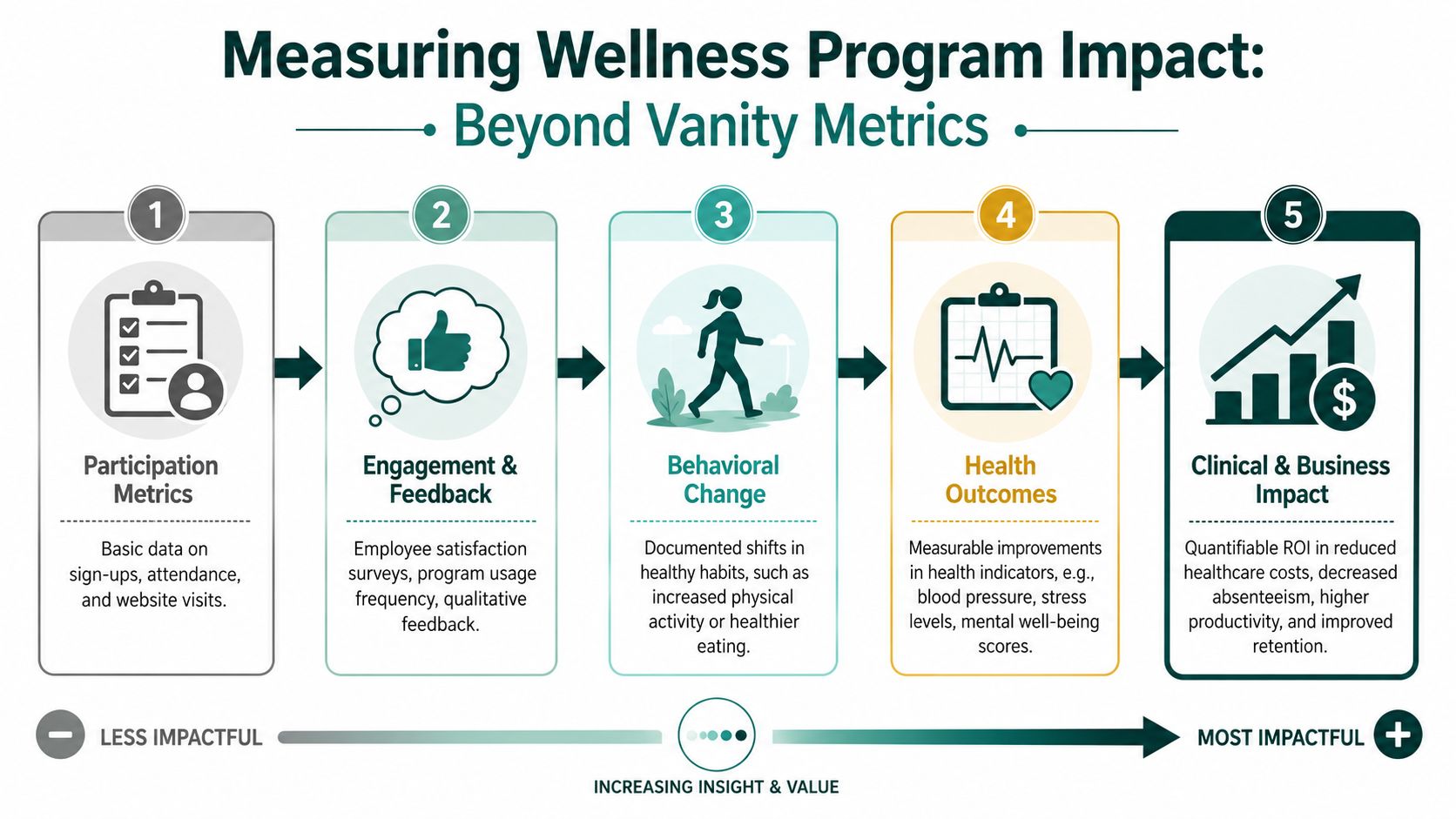
Participation dashboards create a false sense of precision. Leadership can see registrations, clicks, and challenge completions, yet still have no defensible answer to a basic budget question: did employee health risk change in a way that could affect claims, productivity, or future benefits cost?
What to stop treating as proof
Evidence from a randomized workplace wellness trial review found improvements in some self-reported behaviors, but no significant differences in BMI, blood pressure, cholesterol, absenteeism, job performance, or health spending after 18 months. For employers, the implication is straightforward. Activity metrics can describe engagement, but they do not establish value.
A second large workplace wellness study reached a similar conclusion from a different angle. Screening rates increased and stayed higher, but researchers found no significant causal reductions in total medical expenditures, employee productivity, self-reported health, or other health behaviors after more than two years, as detailed in this study on screening effects and downstream ROI limits.
That matters because many programs still overstate weak signals. Common examples include:
Enrollment totals: evidence of awareness, not outcomes
Challenge completion: a sign of short-term participation, not sustained risk reduction
Satisfaction scores by themselves: useful for experience design, weak for financial justification
Screening volume by itself: operational output, not proof that risk was identified early and followed up appropriately
What a stronger measurement model looks like
A stronger model tracks a sequence of value creation, not just a burst of activity at launch.
Leadership should evaluate wellness across four layers:
Reach
Which employee groups engaged, and which did not?Action
Did employees take a preventive step, complete follow-up, or seek care after a risk signal?Clinical impact
Did the program surface meaningful patterns in cardiometabolic, inflammatory, or other preventable risk categories?Business relevance
Do those patterns support better benefit design, earlier intervention, or lower avoidable risk burden over time?
This approach changes the ROI discussion. Instead of asking whether enough employees joined, leaders can ask whether the program identified concentrated risk, reduced barriers to follow-up, and improved the quality of benefit decisions.
Clinical data is what makes that shift possible. Aggregated biomarker trends can show whether a workforce has persistent exposure to issues tied to future cost and disruption, such as poor glucose control. If an employer offers preventive lab access, anonymized reporting can track whether employees are identifying concerns and pursuing follow-up on markers such as Hemoglobin A1c testing for glucose control. That signal is far more useful than attendance counts because it connects wellness spending to underlying health risk, not just visible participation.
Why clinical data changes the leadership conversation
Clinical measurement does not make a wellness strategy impersonal. It makes it auditable.
HR leaders need evidence that stands up in a finance review and still respects employee boundaries. Aggregated and de-identified health insight can meet both requirements. Employees keep privacy over their personal results. Employers gain a clearer view of where risk clusters, where follow-up breaks down, and which program components deserve more investment.
The core question is not how many employees participated. It is whether the program generated useful evidence that justified the spend.
That is the point where wellness becomes easier to defend. A program built on clinical insight can show whether preventive action is occurring soon enough to matter. It can also show where the current design fails, which is often more valuable than a high participation rate with no measurable change.
The organizations with the strongest ROI story do not rely on portal activity as a proxy for impact. They use privacy-conscious clinical reporting to connect wellness to earlier detection, smarter benefit strategy, and a more credible case for continued funding.
Conclusion A Strategic Asset Not an Expense
Consider a fictional mid-sized employer facing a familiar problem. Claims pressure is rising, employees say they're too busy for wellness activities, and leadership has a dashboard full of registrations with no persuasive ROI story. HR could respond the old way by adding another challenge and a larger incentive.
Instead, the company redesigns the program around trust, convenience, and measurable health insight. It reduces friction, clarifies what data stays private, and shifts reporting from participation counts to anonymized patterns tied to preventive action. Employees don't feel monitored. They feel respected. Leadership doesn't just see activity. It sees where risk clusters, where follow-up is weak, and where benefit dollars can do more good.
This reveals a fundamental advantage of employee wellness programs. A credible program doesn't only make the workforce feel supported, though that matters. It gives the organization a smarter way to manage health risk before it becomes a larger financial and operational problem.
Wellness becomes a strategic asset when it produces useful intelligence, not just visible activity. That's the difference between a benefit employees notice and a system leadership can defend. Done well, it builds a culture of proactive health that serves both sides of the employment relationship. Employees get more relevant support. Employers get a stronger, steadier workforce and a better basis for long-term decisions.
FAQs About Employee Wellness Program Benefits
Are employee wellness programs worth it
Yes, but only when they're designed and measured well. The evidence supports potential savings and behavior change, but programs often disappoint when employers rely on participation metrics instead of tracking meaningful outcomes.
What are the most realistic benefits to expect
The most realistic early benefits are better engagement with preventive health and healthier self-reported behaviors. Harder outcomes like lower health spending or measurable clinical change may take longer or may not appear in every program.
Why do employees avoid wellness programs
Most employees don't avoid wellness because they oppose health support. Common barriers include lack of time, unclear program details, and concerns that employers might access personal health information.
How should employers measure wellness ROI
Start with more than participation. Track reach, follow-through, clinically relevant trends in aggregated data, and whether the program helps leadership make better decisions about workforce health risk.
What makes a wellness program feel useful instead of intrusive
Privacy, convenience, and relevance. Employees are more likely to use a program when they understand what it does, how little friction it creates, and what personal information remains private.
Goodlabs is a health platform that gives blood donors free clinical-grade lab panels, run at Quest or LabCorp, and offers the same panels at low cost to anyone who doesn't want to donate. For employers looking to make wellness more measurable, Goodlabs can support a model built around accessible testing, private results, and clearer preventive insight. You can learn more about Goodlabs and explore whether its approach fits a more evidence-based wellness strategy.
Blood test results are informational and not a medical diagnosis. Talk to your physician about what your results mean for you.
Jake Kaiser
jakesjourney.co