



Nutrition & Deficiencies
What Is Absolute Neutrophil Count: Understanding Your ANC

Absolute neutrophil count, or ANC, is the actual number of neutrophils, the infection-fighting white blood cells, in a specific volume of blood. Its main clinical use is estimating infection risk, especially when ANC drops below 1,500 cells/µL, with much higher concern below 500 cells/µL.
That simple definition matters more than it seems. A lot of people look at a CBC and focus on the neutrophil percentage, but the absolute count is what tells you how many of these immune cells are really available in your bloodstream. If you're trying to understand what is absolute neutrophil count, the most useful mindset is this: ANC is less like a grade and more like a headcount.
That's also why a single result can be misleading without context. ANC can shift with stress, exercise, time of day, illness, medications, and recovery. So the question often isn't just “Is this number normal?” It's “Is this a temporary blip, or part of a pattern?”
What Is Absolute Neutrophil Count (ANC)?
The basic definition
A CBC can include several white blood cell numbers, but ANC answers one very specific question. How many neutrophils are available in your bloodstream right now?
Absolute neutrophil count is the measured number of neutrophils in a given amount of blood. On many lab reports, the ANC appears as its own line item. If it does not, it can often be calculated from the total white blood cell count and the neutrophil percentage reported on a CBC with differential.
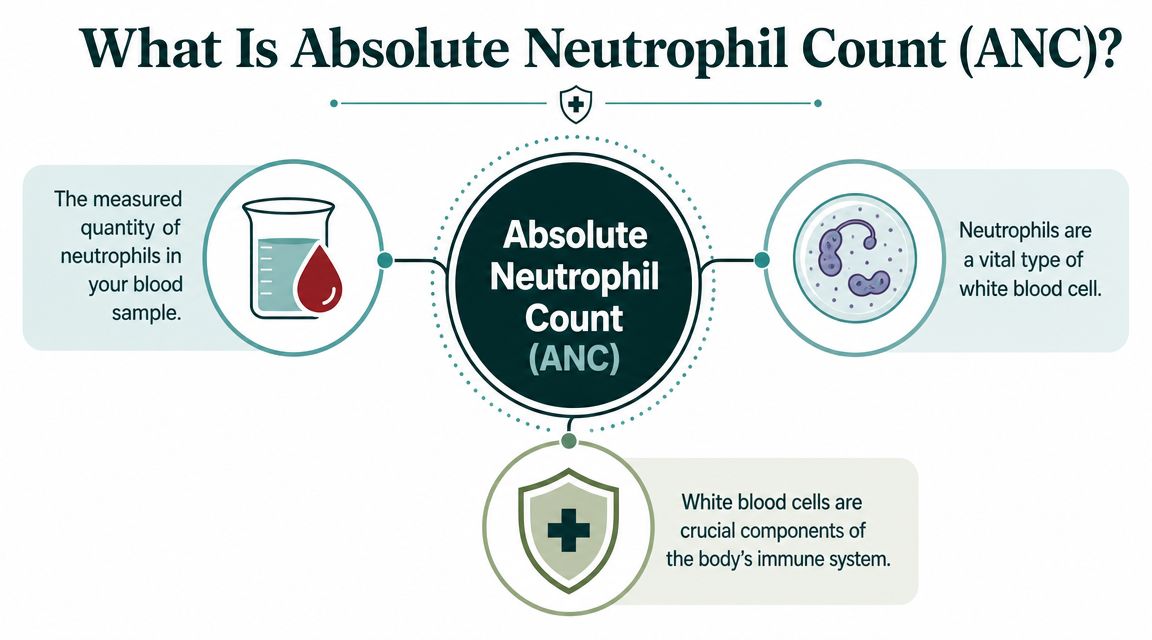
That distinction matters because percentages can be misleading. A report may show a neutrophil percentage that looks ordinary, while the total white blood cell count is low enough that the actual neutrophil count is still reduced.
Another way to frame it is emergency staffing. If 60% of the responders on duty are firefighters, that percentage sounds reassuring. But if only a small crew showed up for the shift, the town still has limited fire coverage. ANC captures the headcount, which is why clinicians often care more about it than the percentage alone.
Some reports also factor in immature neutrophils called bands when ANC is calculated. The exact presentation can vary by lab, so it helps to read the result in the context of the full CBC rather than treating one line as the whole story.
Why the absolute number matters more than the percentage
ANC is useful because it connects the lab result to a real clinical question. Is your body likely to have enough of its early bacterial and fungal defense cells on hand, or is the supply lower than expected?
That does not mean one isolated result always signals danger.
A single ANC value is more like one frame from a movie than the whole plot. Recent illness, medications, cancer treatment, autoimmune conditions, and even normal individual variation can all affect the number. That is why the trend over time, your symptoms, and the rest of your blood work often matter more than whether one result sits just above or below a cutoff.
If you are reviewing a CBC with differential from Quest or LabCorp, ANC is one of the white blood cell measurements worth checking alongside the rest of the report. You can see common blood test options for CBC and related panels if you are trying to understand how this result is typically ordered.
Why Your ANC Is a Critical Immune Health Marker

Neutrophils are your first responders
A large share of your white blood cells are neutrophils. That matters because they are often the first immune cells to react when bacteria or fungi break through normal defenses.
Neutrophils work like the first crew sent to contain a small fire before it spreads. They move quickly to the site of trouble, attack microbes, and help limit early damage while other parts of the immune system catch up. When clinicians look at ANC, they are asking a practical question. Do you have enough of that fast-response crew available right now?
That is why ANC often gets reviewed alongside other inflammation markers in blood testing. A low or high result can make more sense when it is placed next to the rest of the CBC, your symptoms, and the reason the test was ordered.
Why low ANC changes clinical concern
Low ANC matters because infection risk can rise as the number falls. The concern is not the lab value by itself. The concern is whether your body has enough neutrophils on hand to respond quickly if germs get past the usual barriers.
The clearest example is a person with fever during chemotherapy. In that setting, an ANC result can change how urgently a clinician responds, whether repeat testing is needed soon, and whether treatment should happen at home, in clinic, or in the hospital.
David C. Dale, MD, describes neutropenia in the NCBI Bookshelf StatPearls review as a condition in which lower neutrophil levels increase susceptibility to infection. This is the primary reason ANC is so clinically important.
Context still matters. One mildly low result after a recent viral illness may lead to a re-check and watchful follow-up. A very low result with fever, mouth sores, or signs of infection calls for faster action. The trend over time and the person in front of you matter more than treating one number as the whole story.
Here's a short visual explainer if you want to see the concept in motion:
ANC becomes especially important in people receiving chemotherapy, living with bone marrow disorders, taking medicines that can suppress white blood cells, or recovering from infection. In each case, the same number can mean different things depending on symptoms, recent history, and whether the count is stable, falling, or recovering.
Calculating and Understanding ANC Ranges
How ANC is calculated
ANC is not usually measured as its own stand-alone test. It is calculated from numbers already on a complete blood count, using the total white blood cell count and the share of those cells that are neutrophils. Some labs also count bands, which are immature neutrophils, in that percentage.
The formula is:
ANC = total white blood cell count × neutrophil fraction
The process is simple:
Start with the total white blood cell count.
Multiply by the neutrophil percentage, or by neutrophils plus bands if your lab reports it that way.
If your lab report already includes ANC, there is nothing you need to calculate. If you want to check the math for yourself, this ANC and CBC lab value calculator can help.
One detail trips people up. A percentage alone does not tell you how many neutrophils you have. A high neutrophil percentage can still pair with a low ANC if the total white blood cell count is low. That is why clinicians look at the calculated count, not just the percent.
What common ANC ranges mean
For adults, a standard ANC is often cited as about 2,500 to 7,000 cells/µL, while neutropenia is commonly defined as ANC below 1,500 cells/µL. Severe neutropenia is often defined below 500 cells/µL, and neutrophilia is commonly described as an ANC above roughly 7,700 cells/µL, according to this adult neutrophil range reference.
Here's a simple reference table.
Category | ANC Level (cells/µL) | Clinical Significance |
|---|---|---|
Severe neutropenia | Below 500 | Markedly higher infection risk |
Neutropenia | Below 1,500 | Lower-than-expected neutrophil count that needs clinical context |
Standard adult range | About 2,500 to 7,000 | Commonly cited adult reference range |
Neutrophilia | Above roughly 7,700 | Higher-than-expected neutrophil count |
Ranges help, but they are only a starting point.
A single ANC value works best as one clue in a larger picture. The same result can carry very different meaning depending on whether you feel well, recently had a virus, take a medicine that affects bone marrow, or have a count that is stable, falling, or recovering. That is why many clinicians care as much about the trend as the one-time number.
A mildly low result may lead to a repeat test and follow-up. A much lower result, or a drop paired with fever or other signs of infection, calls for faster attention.
What Causes Low or High ANC Levels?
An out-of-range ANC often leads to a bigger question than “Is this normal?” The more useful question is, “What was happening in the body when this blood sample was taken?” ANC works a bit like a snapshot of your infection-fighting front line. If the body has recently battled a virus, responded to stress, or reacted to a medication, that snapshot can look different for a short time.
Low ANC (Neutropenia)
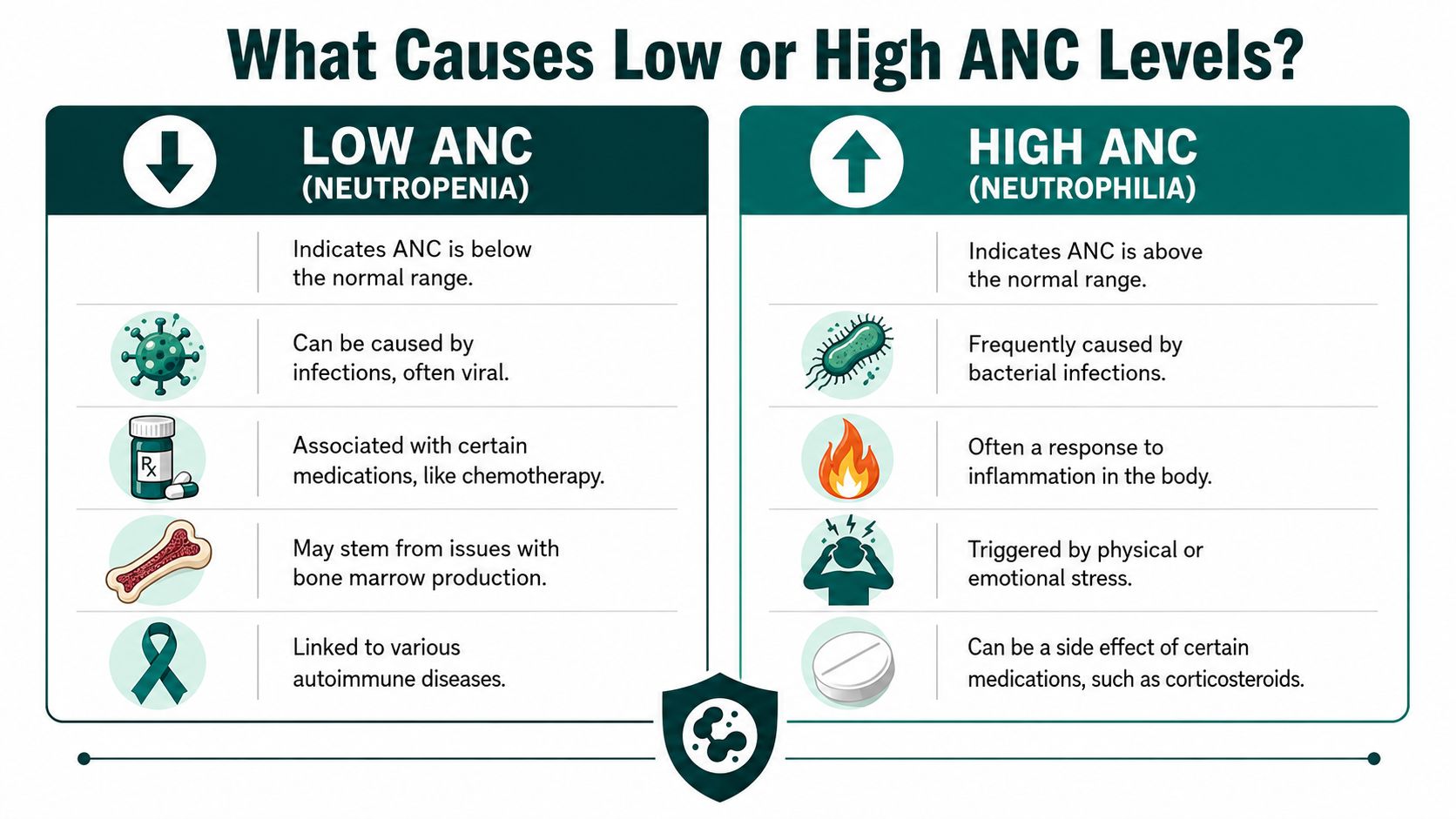
A low ANC gets more attention because neutrophils are one of the body's main rapid-response defenders against infection. The SEER glossary explains that ANC below 1,500/µL is considered neutropenia, and infection concern rises much more when the count drops below 500/µL. It also places that number in clinical context, rather than treating it as a stand-alone diagnosis, in this SEER explanation of neutropenia context.
Several situations can pull ANC down:
Recent viral illness: After a virus, the bone marrow may briefly produce fewer neutrophils, or the immune system may shift its resources during recovery.
Medication effects: Chemotherapy is the best-known example, but some antibiotics, seizure medicines, and other drugs can also lower neutrophil counts.
Autoimmune or inflammatory disease: In some conditions, neutrophils are used up faster, destroyed earlier, or produced less efficiently.
Bone marrow problems: If the marrow is not making blood cells normally, ANC can fall along with other blood counts.
Nutrition-related issues: Low levels of certain nutrients can affect blood cell production, which is one reason patterns linked to nutrient deficiencies may come up during follow-up.
Here is the part many people miss. A mildly low ANC after a recent infection can mean something very different from a falling ANC in someone with fever, mouth sores, or a medicine known to suppress marrow function. The trend and the setting often matter more than the label alone.
High ANC (Neutrophilia)
A high ANC usually means neutrophils have been called into action or pushed into circulation. It is less about “too much immunity” and more about the body reacting to something.
Common causes include:
Bacterial infection
Physical or emotional stress
Inflammation
Corticosteroid use
Smoking or other physiologic stressors
Less commonly, bone marrow disorders
This rise can be temporary. A stressful event, an acute illness, or even the body's normal response to inflammation can shift more neutrophils into the bloodstream for a while, much like sending extra workers onto a busy job site.
The main takeaway is simple. Low and high results are clues, not final answers. A single ANC value becomes much more useful when you place it next to symptoms, recent illnesses, medicines, the rest of the CBC, and whether the count is stable, dropping, or returning to baseline.
How to Interpret Your ANC Test Results
A single result is only a snapshot
One ANC result is a bit like one frame from a movie. It captures a moment, but it does not show the full plot.
ANC can shift for ordinary reasons, including time of day, recent exercise, stress, and short-term body changes. Mildly low or mildly high results are often rechecked after some time because temporary swings are common, as noted in this discussion of ANC variation and repeat testing.
That is why the first question is often not “Is this number bad?” but “What else was happening when this test was drawn?”
When repeat testing may make more sense
If a person feels well, has no warning signs, and the change is mild, repeating the test may be the most useful next step.
The reason is simple. ANC helps estimate infection risk, but the same number can mean different things in different settings. A mild dip after a recent viral illness may recover on its own. The same dip in someone with fever, worsening symptoms, or a treatment that affects bone marrow needs quicker attention.
A calm way to read the result is to check three things:
Symptoms: Fever, chills, mouth sores, or feeling acutely ill make the result more urgent.
Timing: A recent infection, hard workout, or major stress can temporarily shift neutrophil counts.
Trend: One value is a snapshot. Several values show direction.
Tracking results over time makes interpretation clearer, which is why patterns from regular blood testing can be so helpful.
Takeaway: The number matters most when you read it alongside symptoms, recent events, medications, and whether the count is stable, falling, or recovering.
What to review before talking with your doctor
A little preparation can make this conversation much more productive. Instead of focusing only on whether the result sits inside or outside a reference range, gather the clues that shape what the number means.
Review these before your appointment:
Recent illnesses: Even a brief viral infection can affect CBC results for a while.
Medication list: Some prescriptions, cancer treatments, steroids, and other therapies can change ANC.
Past CBCs: Older results help show whether this is new, temporary, or part of a pattern.
Other CBC findings: Changes in white cells, hemoglobin, or platelets can add useful context.
If you started searching for “what is absolute neutrophil count” after seeing one surprising lab result, the practical lesson is this: avoid reading too much into a single value by itself. ANC is most useful as part of the bigger clinical picture.
Taking Charge of Your Health Data
ANC is one of those lab values that becomes much less confusing once you know what it represents. It's a headcount of important immune cells, not just a percentage. And while reference ranges matter, the bigger story often comes from context, symptoms, medications, and trend.
That's especially true with borderline results. A mild one-time change may not mean much on its own. A repeated pattern is more informative. That's why keeping your past CBCs in one place can make future conversations with your doctor much more productive.
If you want a practical way to track biomarkers over time, Goodlabs lets blood donors book a donation and receive free clinical-grade panels through partners such as Vitalant and Inova, with laboratory testing performed by Quest or LabCorp. If donating isn't the right fit, you can also book affordable self-pay testing through Goodlabs test booking or explore donor-based options through Goodlabs donation booking.
Results are informational, not a diagnosis. Talk to your physician.
FAQs: Absolute Neutrophil Count (ANC)
Is ANC the same thing as neutrophil percentage?
No. Neutrophil percentage shows the share of white blood cells that are neutrophils. ANC shows the actual number of neutrophils in a blood sample, which is usually more useful for judging infection risk.
What ANC level is considered low?
Neutropenia is commonly defined as an ANC below 1,500 cells/µL. Severe neutropenia is often defined below 500 cells/µL, which is associated with much higher concern for serious infection.
Can ANC change from day to day?
Yes. ANC can vary with stress, exercise, time of day, recent illness, and other short-term changes. That's why a mildly abnormal result is often repeated instead of being interpreted on its own.
What can cause a high ANC result?
A high ANC may be associated with infection, inflammation, physical stress, emotional stress, or some medications. The meaning depends on the full clinical picture, not just the number by itself.
Should I worry about one mildly abnormal ANC result?
Not always. Mild abnormalities can be temporary. What matters most is whether the result persists, worsens, or appears with fever, symptoms, recent illness, or medication exposures.