


The most common advice on a progesterone blood test is also the least useful: get one number, compare it to a range, and decide whether it's “low” or “normal.”
That approach fails a lot of people.
A progesterone result is only actionable when you know when in the cycle the blood draw happened and what question you were trying to answer. If you test too early, a “low” value may be perfectly normal. If you test at the wrong point in an irregular cycle, the result may tell you almost nothing. And because progesterone can swing sharply even across short time windows, a single draw is a snapshot, not a verdict.
Used well, a progesterone blood test can help confirm recent ovulation, add context to fertility workups, and support discussions about pregnancy-related hormone status. Used casually, it creates confusion. If you've ever stared at a hormone result and wondered what to do next, how to read hormone panel results starts with this same principle: numbers without context don't guide decisions.
Table of Contents
Why Your Progesterone Number Might Be Misleading
A progesterone result without timing context is close to useless.
Clinicians see this mistake all the time. Someone gets a “low” progesterone result, assumes there is a hormone problem, and starts chasing the number. But progesterone is supposed to stay low before ovulation and rise only after ovulation. If you do not know where that blood draw landed in the cycle, you do not know what the result means.
That is the part many articles miss. The lab value matters. The timestamp matters more.
A single progesterone number is only one data point inside a moving pattern. Early follicular progesterone, peri-ovulatory progesterone, mid-luteal progesterone, and progesterone in pregnancy are interpreted differently. The same value can look appropriate, borderline, or concerning depending on whether the sample was collected before ovulation, several days after ovulation, or during a cycle that did not ovulate at all.
Here is the practical rule I use. Do not ask whether the progesterone number is “good” in isolation. Ask whether it matches the biology that should be happening on that specific day.
That is also why random hormone testing creates confusion. If you have ever struggled to make sense of several markers at once, this guide on how to read hormone panel results can help you put the full pattern together instead of overreacting to one lab line.
There are real trade-offs here. One test is simple and convenient, but convenience often costs accuracy. A correctly timed progesterone draw can help confirm ovulation or show whether the luteal phase looks weak. A poorly timed draw can send you toward supplements, repeat testing, or fertility worry that was never warranted. For a broader clinical overview of what causes low progesterone, that resource covers the common drivers well.
The takeaway is simple. Progesterone is not a static scorecard. It is a timing-sensitive signal, and timing is what turns a lab result into something you can use.
The True Role of Progesterone in Your Body
Progesterone gets labeled the “pregnancy hormone,” but that shorthand is too narrow. It's more accurate to think of it as a signaling hormone that helps the body shift gears after ovulation.

It's not just a fertility hormone
Progesterone helps prepare the uterine lining for a possible pregnancy, but that's only part of the story. In real life, people often notice progesterone shifts through changes in cycle rhythm, sleep, mood, and overall sense of stability across the month.
It also works in relationship with estrogen. Estrogen helps build. Progesterone helps organize and steady. When those two aren't in sync, symptoms can feel messy, even if a lab result looks superficially “in range.”
If you want a broader clinical overview of what causes low progesterone, that resource does a good job of laying out the common drivers in plain language.
Think of progesterone as a stabilizer
A useful analogy is an orchestra. Estrogen often acts like the section building energy and momentum. Progesterone acts more like the conductor bringing timing, structure, and control after ovulation.
That's why a progesterone blood test can be valuable beyond a yes-or-no fertility question. It can provide insight into whether the second half of the cycle is unfolding as expected.
Progesterone matters most when you understand it as a changing signal, not a permanent trait.
The Critical Importance of Cycle Timing
A progesterone result without timing context is close to useless. The same number can suggest healthy ovulation, normal pre-ovulatory physiology, or a poorly timed test. The lab value matters. The day you drew it matters just as much.
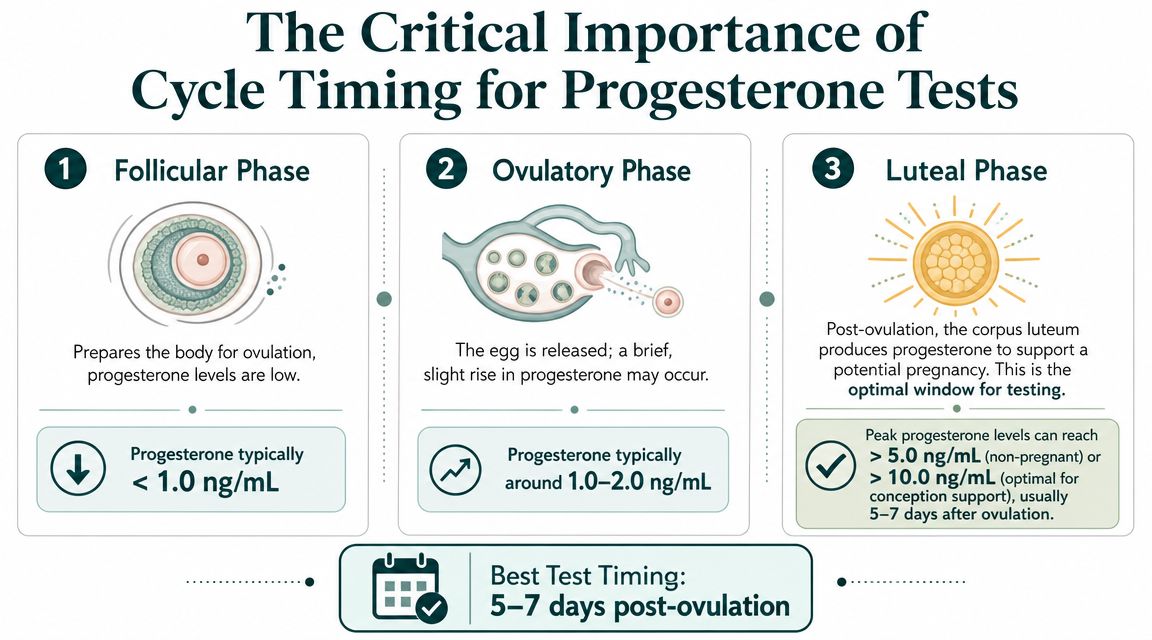
Why the same result can mean different things
Progesterone is supposed to be low before ovulation and higher after ovulation, once the corpus luteum starts producing it. That means a “low” result only means something if you know where you are in the cycle.
A practical example helps. If someone tests on cycle day 21 and gets a low progesterone result, many clinicians will flag possible low luteal progesterone. But if that person ovulated on day 18, the blood draw happened too early to answer the question well. If ovulation happened on day 12, the same result carries a different meaning. Same number. Different context. Different decision.
That is the mistake I see most often with progesterone testing. People focus on the value and ignore the biology that produced it.
Progesterone also rises in pulses across the day, so one draw is only a snapshot. For a useful snapshot, the goal is to test in the right post-ovulation window. A practical guide from Lara Briden on the right way to test progesterone explains why timing the draw about 5 to 7 days after ovulation, or about 7 days before the next period, gives a much more actionable result than using a random calendar date.
When to test if you want useful data
For ovulation confirmation, anchor the test to ovulation, not to a generic “day 21” rule. Day 21 only works in a textbook 28-day cycle with ovulation around day 14. Real cycles are often earlier, later, or inconsistent.
Use ovulation predictor strips, basal body temperature, cervical mucus changes, or a combination of those markers to estimate ovulation first. Then schedule the blood draw for the mid-luteal window. That approach gives a cleaner answer to the key question: did ovulation happen, and is progesterone rising when it should?
If that is your goal, the ovulation confirmation testing option is designed around that specific use case rather than a broad hormone screen.
A short explainer can help too:
Progesterone Reference Ranges in Context
Reference ranges are useful. They're just not interchangeable across cycle phases or pregnancy stages.
UCSF Health reports <1 ng/mL pre-ovulation and 5–20 ng/mL mid-cycle. In pregnancy, Mayo Clinic Laboratories lists 11–44 ng/mL in the first trimester, 25–83 ng/mL in the second, and 58–214 ng/mL in the third, while UCSF reports broader third-trimester values of 48 to 150 to 300+ ng/mL (UCSF Health serum progesterone).
Reference table by phase and pregnancy stage
Context | Reference information |
|---|---|
Follicular phase | ≤0.89 ng/mL from Mayo Clinic Laboratories |
Pre-ovulation | <1 ng/mL from UCSF Health |
Ovulation threshold | ≤12 ng/mL from Mayo Clinic Laboratories |
Luteal phase | 1.8–24 ng/mL from Mayo Clinic Laboratories |
Mid-cycle | 5–20 ng/mL from UCSF Health |
First trimester | 11–44 ng/mL from Mayo Clinic Laboratories |
Second trimester | 25–83 ng/mL from Mayo Clinic Laboratories |
Third trimester | 58–214 ng/mL from Mayo Clinic Laboratories |
Third trimester broader UCSF range | 48 to 150 to 300+ ng/mL from UCSF Health |
The point isn't to self-diagnose from a table. The point is to stop treating progesterone as a single universal score. A “normal” result is only normal for the right context.
That's the same distinction behind optimal vs. normal blood test ranges. “In range” can still be unhelpful if the test was timed poorly for the question you're asking.
How to Get an Accurate Progesterone Test
A progesterone result can look precise and still be clinically useless. The lab may report a clean number to the decimal place, but if the blood draw missed the right window, that precision does not answer the question you care about.
Good testing starts with timing, then logistics, then interpretation.
Goodlabs is a health platform that gives blood donors free clinical-grade lab panels (run at Quest or LabCorp), and offers the same panels at low cost to anyone who doesn't want to donate.

What actually improves test accuracy
Start by deciding what you want the test to tell you. Are you trying to confirm that ovulation likely happened, check luteal function, monitor early pregnancy, or see whether progesterone therapy is getting you into the expected range? The right test day depends on that goal.
For cycle-based testing, use ovulation as the anchor point, not a generic calendar date. Ovulation predictor kits, basal body temperature, cervical mucus changes, or a well-tracked cycle can all help narrow the window. If cycles are irregular, this matters even more.
A few habits make the result more useful:
Match the draw to the question: A fertility workup, pregnancy check, and hormone-therapy follow-up do not use the same timing logic.
Track the cycle in writing: Note suspected ovulation day, first day of the last period, cycle length, symptoms, and any spotting.
Repeat under similar conditions: If you are comparing month to month, test in the same relative phase of the cycle.
Record hormone use clearly: Oral progesterone, vaginal progesterone, and injections can affect interpretation differently.
Progesterone also fluctuates across the day, so one blood draw is a snapshot, not a full movie. That does not make serum testing useless. It means the sample has to be placed in the right clinical context, and sometimes repeated testing gives a clearer picture than one isolated result.
A progesterone number without timing notes is often less informative than people expect.
If you're sorting through fertility questions and want broader education alongside lab testing, Bornbir's expert fertility resources can complement the clinical side.
Why access matters
I see the same practical mistake over and over. Someone gets tested on the day that fits the appointment schedule, not the day that fits their biology. Then they spend weeks trying to interpret a number that was never set up to be meaningful.
That is why direct access can help. Faster ordering and easier scheduling make it more realistic to test at the right point in your cycle instead of settling for a convenient but poorly timed draw. If you want that option, the direct-access progesterone blood test through Goodlabs is one route.
The goal is not to collect a hormone score. The goal is to get a result you can use.
FAQs About the Progesterone Blood Test
Is there a best day for a progesterone blood test
Yes. The most useful timing is usually about 5 to 7 days after ovulation or roughly 7 days before the next period when the goal is to assess post-ovulation progesterone activity, as noted earlier.
Can I do a progesterone blood test with irregular cycles
Yes, but calendar-day testing is less reliable. With irregular cycles, it's better to anchor the test to suspected ovulation rather than assume a standard cycle pattern.
Does a progesterone blood test confirm ovulation
It can help confirm recent ovulation when timed correctly. That's one of its most common clinical uses, especially when interpreting whether the corpus luteum is functioning as expected.
Is progesterone testing only for fertility
No. Beyond fertility, progesterone testing can help assess concerns such as ectopic pregnancy risk, miscarriage risk, pregnancy monitoring, abnormal uterine bleeding, ovarian or adrenal disorders, and response to progesterone replacement therapy. Interest is also growing in urine progesterone metabolite testing, called PdG, as a less invasive adjunct in some settings (Healthline overview of serum progesterone testing).
Should I choose serum progesterone or urine PdG
It depends on the use case. Serum blood testing remains important when clinicians want a direct lab value in clinical context. Urine PdG is gaining attention as an adjunct or alternative in some reproductive monitoring situations.
If you want a wider hormone view instead of a single marker, a women's hormone test option can provide more context for the conversation with your physician.
The value of a progesterone blood test isn't the number by itself. It's the decision that number helps you make when timing, symptoms, and goals are all aligned. Get the timing right, and the test becomes useful. Get the timing wrong, and even a “normal” result can send you in the wrong direction.
If you want a simpler way to access hormone testing on your schedule, Goodlabs offers direct access to clinical-grade blood tests through CLIA-certified partner labs, with free lab panels available for many blood donors and low-cost options for non-donors.
Blood test results are informational and not a medical diagnosis. Talk to your physician about what your results mean for you.

Jake Kaiser
jakesjourney.co