


Most advice on cholesterol is too simplistic. If your number is lower, you're told to celebrate. If it's higher, you're told to worry. That framing misses a useful clinical reality. Cholesterol can be too low, and when it is, the main question usually isn't “how do I raise it fast?” but “what changed, and why?”
That's the counterintuitive part. A low result can be harmless in one person, medication-related in another, and a clue to an underlying problem in someone else. The smarter move is to interpret the pattern, not worship the lab flag.
People who care about performance, longevity, or prevention often focus on optimization. That's fine, but optimization without context can turn into overconfidence. A low LDL or low total cholesterol isn't automatically a win. It's a data point that belongs next to symptoms, medications, diet, family history, and trendline. If you want a broader framework for taking control of cholesterol, start there. Then get more specific.
The Hidden Side of Cholesterol Health
Why a low number can mislead
The usual public message is that lower cholesterol is always better. That works as a broad oversimplification for high-risk cardiovascular prevention, but it breaks down when you apply it blindly to an individual lab result.
A low cholesterol result can mean very different things. It might reflect genetics. It might reflect aggressive treatment. It might show up during periods of restricted eating, illness, or metabolic stress. Sometimes it's stable and unsurprising. Sometimes it's new, unexplained, and worth attention.
Practical rule: Don't call a cholesterol result “good” or “bad” until you know whether it's stable, intentional, and matched to the rest of the clinical picture.
Many self-trackers often miss the signal. They focus on the headline number and skip the structure underneath it. LDL is one marker. Particle measures, inflammation markers, liver markers, thyroid status, and symptom changes often tell you more about whether the result is reassuring or concerning. If you want a deeper lipid view than a standard panel provides, an NMR LipoProfile test can help separate “low LDL on paper” from what the lipoprotein pattern is doing.
What a smarter lipid review looks like
A useful interpretation starts with questions, not assumptions:
Was this intentional? A low result after medication changes is a different story than a spontaneous drop.
Is it new? A sudden decline carries a different meaning than a lifelong pattern.
Does it fit the rest of the labs? Low cholesterol next to abnormal liver, inflammatory, or nutritional markers deserves more attention.
Are there symptoms? Weight loss, appetite change, fatigue, GI issues, or thyroid symptoms shift the frame.
That's the hidden side of cholesterol health. Cholesterol too low is less a diagnosis than a prompt to investigate context.
What Exactly Is 'Cholesterol Too Low'?
The thresholds clinicians commonly use
There isn't one universal cutoff, but clinical references commonly use similar thresholds. Very low cholesterol is often defined as total cholesterol under 120 mg/dL or LDL under 50 mg/dL, while Mayo Clinic notes LDL is considered very low if it is below 40 mg/dL and Cleveland Clinic describes hypocholesterolemia as total cholesterol below 116 mg/dL and/or LDL below 50 mg/dL. Cleveland Clinic frames hypocholesterolemia as having total cholesterol and/or LDL below the level seen in more than 9 out of 10 people, and notes it can point to an underlying illness — as also summarized in WebMD's review of low cholesterol.
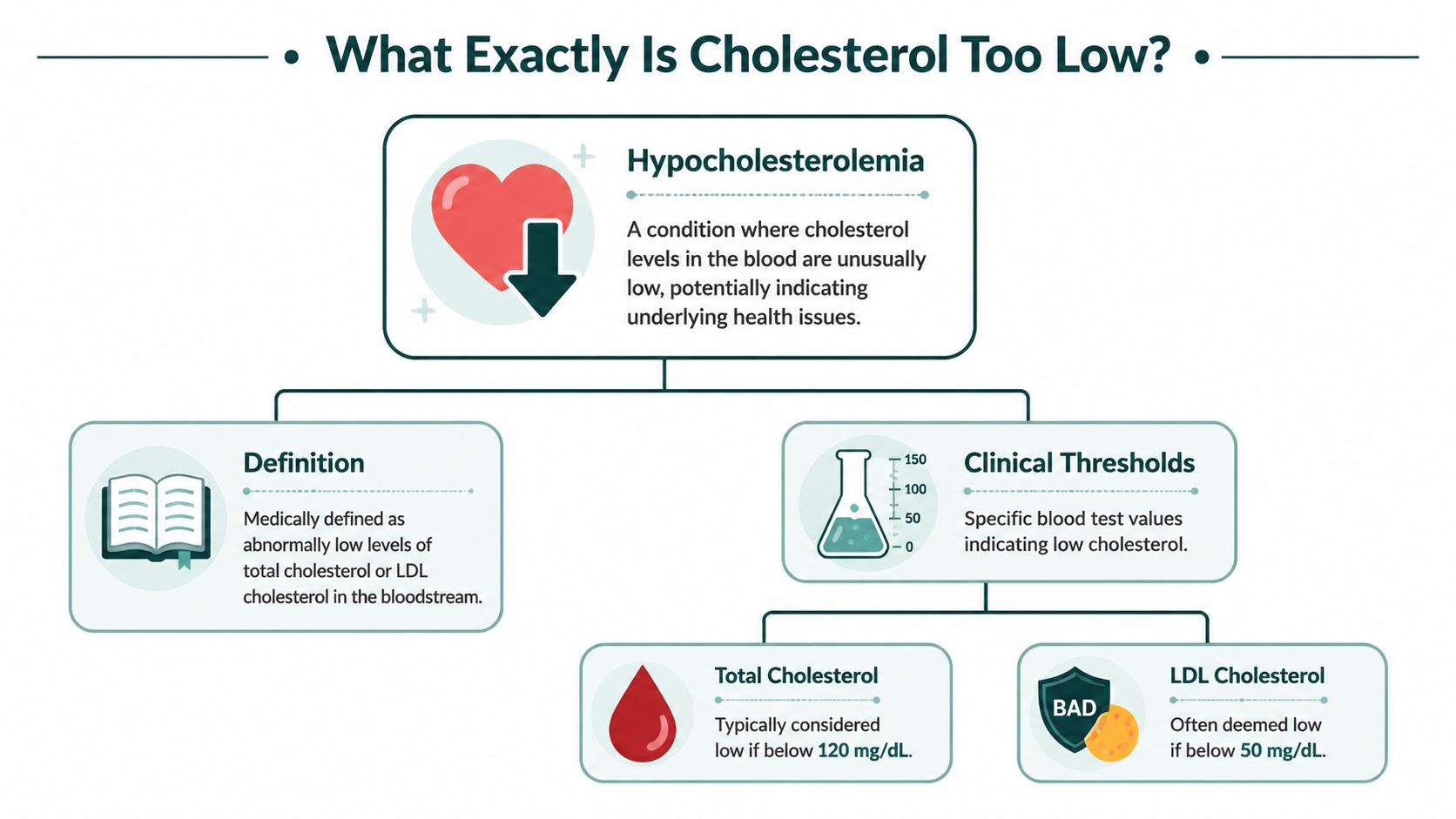
Those cutoffs are guideposts, not automatic danger zones. They tell you when a result deserves interpretation, not when to panic.
Goodlabs is a health platform that gives blood donors free clinical-grade lab panels (run at Quest or Labcorp), and offers the same panels at low cost to anyone who doesn't want to donate. If you're trying to verify whether a surprising LDL result is real or persistent, a direct LDL cholesterol test is one way to get a cleaner look.
For a quick visual overview of the topic, this video is useful:
Why LDL, total cholesterol, and HDL aren't the same question
People often say “my cholesterol is low” when they mean very different things.
Marker | What it means in this discussion | Why it matters |
|---|---|---|
Total cholesterol | Broad summary measure | Can be low for several reasons, including changes outside classic heart risk |
LDL | The marker most people focus on | Very low LDL may be intentional, genetic, or a clue that something else is going on |
HDL | A separate issue | Low HDL isn't the same as hypocholesterolemia and shouldn't be interpreted as the same problem |
A complete lipid interpretation starts by naming the actual marker that's low.
If you've been told you have cholesterol too low, confirm which number triggered that comment before you decide what it means.
Common Causes of Unusually Low Cholesterol
When low cholesterol is a downstream effect
One of the most useful patterns in the literature is this: falling cholesterol over time can matter more than stable low cholesterol. A long-term epidemiologic pattern linked low total cholesterol, defined in one analysis as <4.7 mmol/L (<180 mg/dL), with excess risk of hepatic disease and cancer, but the increased risk was seen with falling cholesterol over time rather than with stable low levels. That supports the idea that an underlying illness may drive cholesterol down before diagnosis, rather than low cholesterol itself being the primary cause, as described in this Circulation analysis.
That's the key strategic point. The body doesn't read your labs in isolation. If cholesterol drops because thyroid activity rises, liver function changes, nutrient intake falls, or systemic disease alters metabolism, the cholesterol result is an effect.
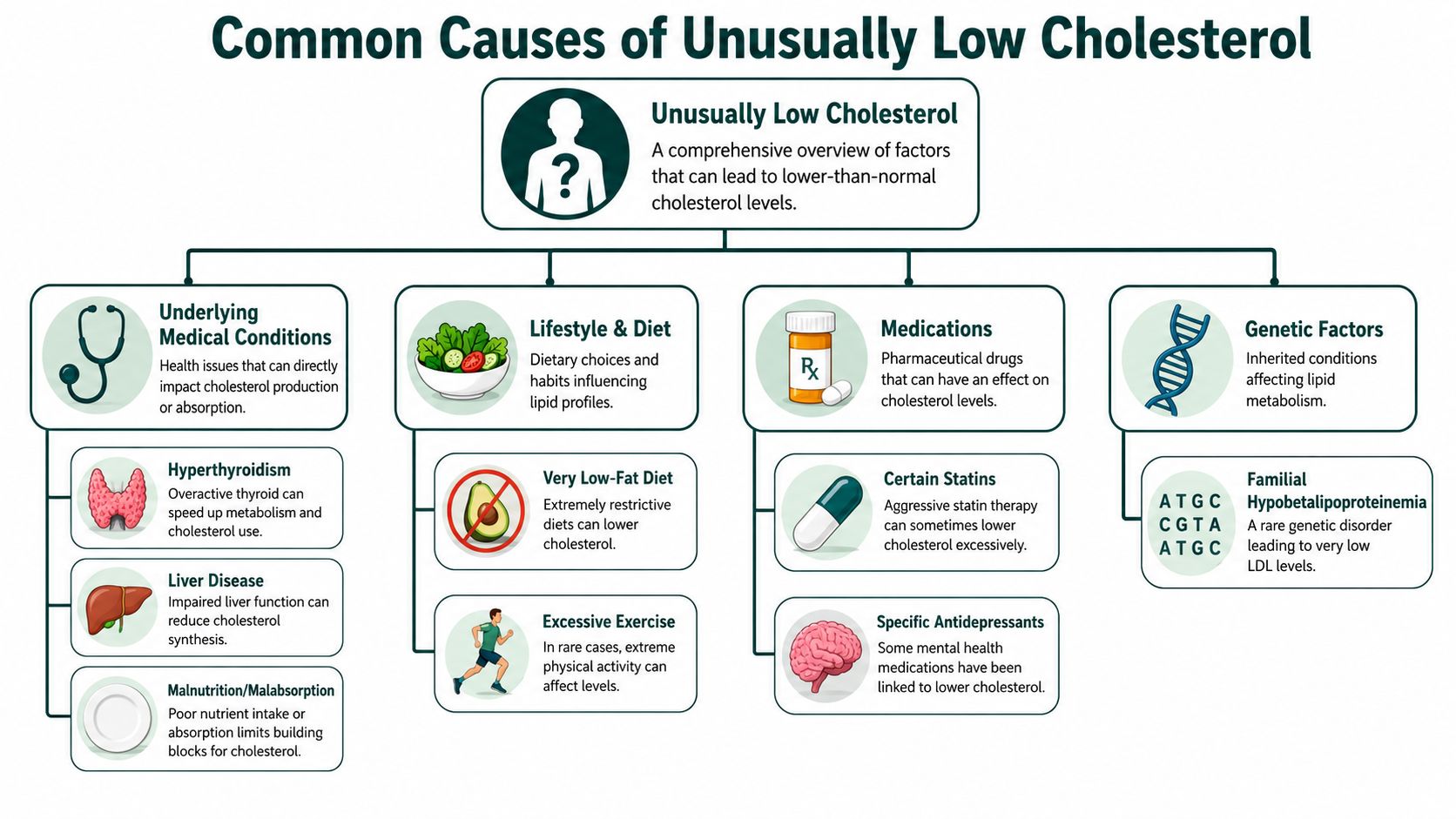
Four practical buckets to investigate
Most real-world causes fit into a few broad categories.
Underlying illness
Cleveland Clinic notes that low cholesterol can be linked to underlying illness such as hyperthyroidism, malnutrition, liver disease, sepsis, HIV, or cancer, as reflected in the earlier clinical-reference summary. Mechanistically, these conditions can change cholesterol synthesis, absorption, transport, or turnover.
Nutrition and absorption
A very restrictive diet, prolonged under-eating, malabsorption, or major unintentional weight loss can all lower cholesterol. In practice, the process of health optimization sometimes backfires. People tighten diet quality, cut calories hard, remove whole food categories, then assume every lower marker is progress.
Low cholesterol after a major nutrition change isn't always a badge of metabolic excellence. Sometimes it's your first clue that intake, absorption, or recovery has slipped.
Medication effect
This category is often overlooked because it feels obvious. If someone is on statins or other lipid-lowering therapy, low LDL may reflect treatment intensity. That isn't automatically a problem, but it does change the next question from “why is this low?” to “is this level appropriate for this person, with this history, and this response?”
Genetics
Some people naturally run low LDL because of inherited differences in lipid metabolism. In those cases, the pattern is often long-standing and not accompanied by the red flags you'd worry about in an acquired drop.
A practical screen looks like this:
Check timing. Did the low result appear after a new medication, illness, or diet shift?
Check trajectory. Was it low once, or has it been low across multiple measurements?
Check companions. Are there changes in weight, appetite, thyroid symptoms, liver markers, or energy?
Check family pattern. Do relatives also run low cholesterol without obvious illness?
Potential Health Implications Acknowledged by Research
What the observational data actually shows
If you search this topic, you'll find two bad interpretations. One says low cholesterol is always dangerous. The other says any concern is nonsense. The data supports neither extreme.
A major U.S. cohort study published in 2022 followed 347,941 adults for a mean 5.64 years and found that people with LDL-C below 70 mg/dL had higher mortality than those with LDL-C 100–129.9 mg/dL, after adjustment for age, sex, race/ethnicity, education, socioeconomic status, lifestyle factors, C-reactive protein, body mass index, and other cardiovascular risks. The adjusted hazard ratios were 1.45 for all-cause mortality, 1.60 for cardiovascular disease mortality, and 4.04 for stroke-specific mortality, according to the JAHA cohort study.
Another large cohort analysis found that low cholesterol (<4.14 mmol/L) was associated with a 49% higher all-cause mortality risk in men and a 50% higher risk in women versus moderate cholesterol (4.14–5.17 mmol/L), with excess deaths concentrated in cancer, hemorrhagic stroke, and heart failure excluding myocardial infarction. The authors argued that unexpectedly low cholesterol can function as a clinical signal to evaluate for secondary causes, as reported in this PMC cohort analysis.
What to do with that information
Those findings matter, but they don't mean low cholesterol directly caused the bad outcomes.
Observational studies show association, not proof of mechanism. People with very low cholesterol may differ in ways that no adjustment fully captures. Some may have undiagnosed disease driving both the low result and the later outcome. Others may have been treated because of existing risk. This is why the trend matters more than the isolated number.
The useful takeaway isn't “low cholesterol is dangerous.” It's “unexpectedly low cholesterol deserves context.”
For heart-risk interpretation, LDL alone also has limits. ApoB, or apolipoprotein B, estimates the number of potentially atherogenic lipoprotein particles. In someone with a puzzling LDL result, an Apolipoprotein B test may help put the lipid picture into a more actionable frame alongside the rest of the workup.
How to Interpret Your Results and Plan Next Steps
Use the trend before you use the label
The most rational response to cholesterol too low isn't fear. It's sequence.
Start with chronology. Was this result present last year? Did it follow a medication change, a cut, a bulk, a gastrointestinal issue, a thyroid shift, or a period of poor recovery? One low value can be noise. A downward drift across multiple tests is different.

Build a better follow-up plan
A practical follow-up plan usually includes a repeat lipid check, review of medications and supplements, and broader labs that fit the likely cause. If the picture suggests under-fueling or over-restriction, nutrition quality matters. For people trying to improve fat intake without defaulting to random internet advice, this overview on understanding hemp seed omegas is a useful example of thinking in food quality rather than just “eat more fat.”
Use a full lipid panel when you need context, not just a single LDL line item. Then review the result with your physician, especially if the low value is new, unexplained, or paired with symptoms.
A short checklist helps:
Repeat the test if the result is unexpected.
Review recent changes in diet, training, body weight, medications, and illness.
Look outside cholesterol at thyroid, liver, inflammation, and nutrition-related markers if your clinician agrees.
Compare against prior results instead of judging one snapshot.
Escalate promptly if the drop is sudden or accompanied by concerning symptoms.
FAQs Cholesterol Too Low
Can cholesterol be too low without symptoms
Yes. Many people won't feel anything specific. That's why unexpectedly low cholesterol often gets discovered on routine labs rather than from a symptom pattern alone.
Should you try to raise low cholesterol with diet alone
Not automatically. If the result is new or unexplained, self-treating with more dietary fat can distract from the underlying problem. Find out whether the number reflects diet, medication, genetics, or an underlying condition first.
Is LDL under 50 always dangerous
No. It can be intentional, stable, and appropriate in some contexts. It becomes more important to evaluate when it's a new finding, part of a sharp downward trend, or paired with other abnormal findings.
What tests help put low cholesterol in context
A broader lipid view helps most. A standard lipid panel, particle-related markers, and clinician-guided review of thyroid, liver, inflammation, and nutrition markers can clarify whether the result is benign or a signal to investigate. If you want a more detailed lipoprotein feature, small dense LDL testing can add context in selected cases.
If you want to track cholesterol trends over time instead of reacting to a single flagged result, Goodlabs offers access to clinical-grade blood testing through CLIA-certified partner labs, with free panels available for eligible blood donors and low-cost options for non-donors. That kind of longitudinal view may help identify whether a low result is stable, intentional, or worth a deeper conversation with your physician.
Blood test results are informational and not a medical diagnosis. Talk to your physician about what your results mean for you.

Jake Kaiser
jakesjourney.co