

General Wellness and Longevity
Understanding Your Blood Test Results Hemoglobin A1c

Jake Kaiser
jakesjourney.co

A blood sugar result can look clear on paper and still mislead you in real life. That's the gap often overlooked with blood test results hemoglobin A1c. They see a percentage, compare it to a chart, and assume the story is complete.
It usually isn't.
Beyond the Snapshot What Your Hemoglobin A1c Really Shows
A fasting glucose test is a snapshot. It tells you what your blood sugar looked like at one moment in time. That can be useful, but it can also miss the larger pattern.
Hemoglobin A1c is closer to a report card than a snapshot. It reflects long-term blood sugar exposure over the past 2 to 3 months, roughly the 90-day lifespan of red blood cells, according to MedlinePlus on the hemoglobin A1c test. Instead of showing one morning's number, it shows how much glucose has been sticking to hemoglobin over time.

That's why A1c became such a central marker in diabetes care. It smooths out the noise. A stressful morning, a poor night of sleep, or an unusually light dinner the night before can all affect a single glucose reading. A1c is much harder to game by accident.
Why people get confused by blood sugar testing
Most confusion comes from mixing up three different ideas:
A momentary glucose reading tells you what's happening right now.
A1c tells you the broader pattern over recent months.
Symptoms and context tell you whether the number matches your real physiology.
If you're comparing your current results across metabolic markers, a broader metabolic health test menu can help you see whether A1c fits with the rest of the picture.
A1c is powerful because it summarizes exposure over time. It's imperfect because biology is rarely average.
That distinction matters. The smartest readers don't just ask, “Is my A1c high?” They ask, “Does this A1c fit the rest of the evidence?”
How to Read Your Hemoglobin A1c Results
What does a result like 5.8% or 6.6% mean once you are staring at the lab report?
Start by treating A1c like a category marker. The percentage matters, but the first job is simple: place it in the right range. The American Diabetes Association diagnostic criteria use these cutoffs for diagnosis and screening.
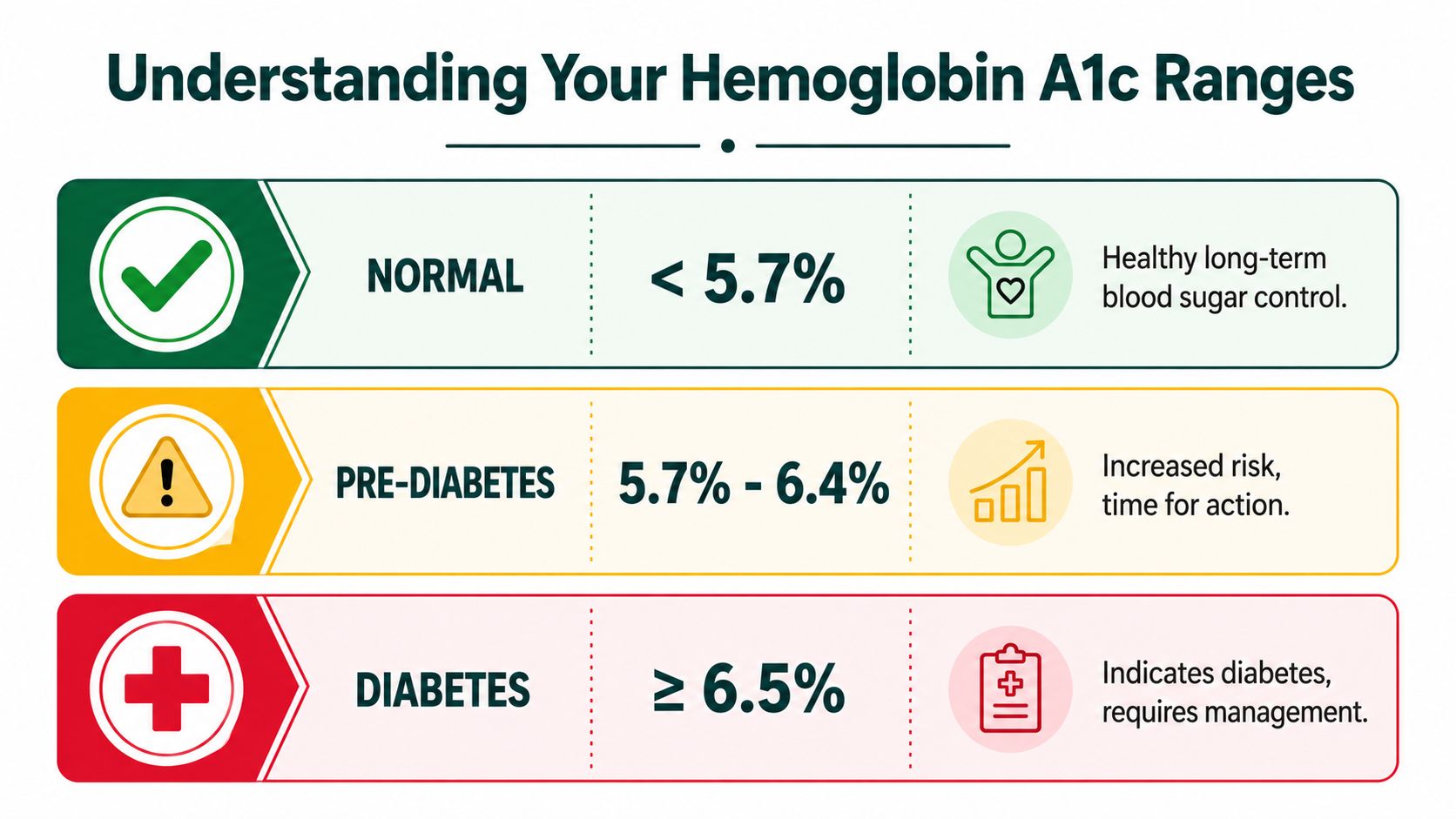
Category | A1c Result (%) |
|---|---|
Normal | <5.7% |
Prediabetes | 5.7% to 6.4% |
Diabetes | ≥6.5% |
Those ranges are the map. They are not the whole trip.
A result below 5.7% usually falls in the expected range. A result from 5.7% to 6.4% suggests prediabetes. A result of 6.5% or higher can support a diabetes diagnosis, though clinicians often confirm it with repeat testing or another glucose-based test if the situation is not straightforward.
If you already have diabetes, many care plans use an A1c goal below 7.0%, but that target is individualized. Age, medications, pregnancy, risk of low blood sugar, and other health conditions can all shift the goal. A younger adult using only lifestyle treatment may have a different target than an older adult with heart disease or frequent hypoglycemia.
A short explainer can help if you want a visual walkthrough:
What about mmol/mol on international reports
Some labs report A1c in mmol/mol instead of percent. It is the same marker shown in a different unit system, like reading temperature in Fahrenheit or Celsius.
Use your lab's reference range rather than trying to convert it in your head. What matters first is where the result lands clinically, then whether it matches the rest of your glucose picture. If you need a same-day comparison point, a fasting glucose blood test can add useful context.
Read the number in context, not in isolation
Here is the part many basic guides skip. A1c is good for classification, but a single result does not always reflect your real blood sugar exposure perfectly. If the number seems out of character, compare it with prior A1c results, home glucose readings, or post-meal blood sugar insights.
That cross-check matters because some people get a misleading A1c from conditions that affect red blood cells, including some forms of anemia, recent blood loss, kidney disease, hemoglobin variants, or recovery after transfusion. So read the category first. Then ask a better question: does this result fit the rest of the evidence?
Reading rule: Start with the category. Then compare with your previous results and other glucose data. Then ask whether anything could be skewing the test.
That is how you turn an A1c from a scary percentage into a usable metabolic signal.
How A1c Translates to Average Blood Sugar
A1c percentages can feel abstract. A number like 5.8% or 6.3% doesn't have the same immediate feel as a glucose reading you can picture on a meter.
Why the number feels abstract
The easiest mental model is this: A1c estimates your average blood sugar exposure over time, not your best day and not your worst day. It's the broad pattern.
That's why people often pair A1c with fasting or direct glucose testing. If you want a more immediate glucose marker, a dedicated glucose blood test can add useful context.
A1c also won't show daily spikes very well. Someone can have a reasonable A1c and still have noticeable rises after meals. That's why practical guidance on post-meal blood sugar insights can be helpful when your lab result doesn't seem to match how you respond to food.
Why recent weeks matter more than you think
A lot of people think A1c is a simple average across three equal months. It isn't.
Labcorp explains that A1c is a weighted average, with about 50% of the result driven by glucose levels in the 30 days before sampling in its hemoglobin Hb A1c test explanation. That means recent changes in eating, illness, exercise consistency, or medication adherence can influence the test more than older weeks.
That creates two very practical realities:
Improvement can show up sooner than people expect. If your habits changed recently, A1c may start reflecting that.
A rough month can matter a lot. Even if earlier weeks were better, the latest stretch carries more weight.
This is one reason A1c works well for tracking trends but not for explaining every day-to-day glucose swing.
When Not to Trust Your A1c Number
Most articles stop being useful at this point. They give you the ranges, maybe mention “talk to your doctor,” and move on. But some A1c results are misleading because the biology underneath the test has changed.

Red blood cell turnover can distort the result
A1c depends on how long red blood cells stay in circulation. If they live a shorter time than expected, they have less time to collect glucose. If they stay around longer, the reading can drift upward even if your glucose pattern hasn't changed as much as the test suggests.
A peer-reviewed review notes that conditions changing red blood cell lifespan can distort A1c. Acute or chronic blood loss, hemolytic anemia, and recent transfusions can falsely lower A1c, while iron deficiency anemia can falsely increase it, according to this review on pitfalls in hemoglobin A1c measurement.
That means a neat-looking percentage can be biologically off target.
Transfusions and blood loss can break the shortcut
A recent transfusion is especially important. In that setting, the A1c may become difficult to interpret because the red blood cells in circulation may no longer reflect your own recent glucose exposure in a clean way.
Here's the practical problem. A1c assumes your red blood cells have been living through your recent blood sugar environment. If some of those cells arrived from outside your body, that assumption weakens.
Practical rule: If you've had recent blood loss, a transfusion, or known anemia, ask whether your A1c is reliable before acting on it.
This is also where people with suspected inherited red-blood-cell differences may need a deeper look. If that's on your radar, a hemoglobinopathy evaluation can help clarify whether a hemoglobin variant could be part of the picture.
When to ask about alternate testing
If the A1c doesn't match your symptoms or doesn't fit your other glucose results, don't force the story. Ask for confirmation.
Situations that should raise your suspicion include:
Mismatch with glucose readings: Your direct glucose values seem consistently higher or lower than the A1c suggests.
Known blood conditions: Anemia, hemolysis, or anything affecting red blood cells can distort the result.
Recent transfusion or blood loss: The number may not reflect your true recent average.
A sudden change that seems too good or too bad: Sometimes the test is reacting to altered cell turnover, not just altered glucose.
In those cases, clinicians often look to plasma glucose, repeat testing, or shorter-window markers. The core idea is simple. If the red blood cell biology is unstable, use tests that depend less on that biology.
What to Do With Your A1c Results
What should you do once you have the number in front of you?
Start by treating A1c like a 3 month report card for blood sugar, then asking one more question. Does this grade match the rest of the story? A1c is useful because it shows pattern, not a single moment. But a useful marker still needs context before you make decisions from it.
Use the result to guide your next question
A higher than expected A1c does not tell you why it is high. It tells you where to look next. Compare the result with your fasting glucose, post meal readings if you have them, symptoms, sleep pattern, medications, recent illness, and any known red blood cell issues.
That step matters because treatment decisions should fit the biology in front of you, not just the percentage on the lab report.
Small changes also deserve perspective. A1c has normal lab variation, so a tiny shift does not always mean your metabolism changed in a meaningful way. Look for direction over time. One reading can raise a flag. Several readings, interpreted with the right context, are much more useful for action.
Build a plan around trends, not a single lab line
Your next move depends on whether the result fits your broader glucose picture.
If it does fit, use it as a baseline. If it does not fit, ask your clinician what could be distorting it and whether you need a direct glucose measure or a shorter window marker before changing your plan. That is the deeper skill with A1c. You are not only reading the number. You are testing whether the number deserves your trust.
If you want a wider view of metabolic risk rather than relying on A1c alone, a Diabetes Risk Index test can add context around where your glucose regulation may be headed.
A practical next-step checklist:
Write down the context: Note recent illness, medication changes, menstrual changes, supplements, or anything else that could affect the result.
Match it against direct glucose data: Fingerstick, fasting glucose, or continuous glucose data can show whether the A1c story holds up.
Ask about retesting cadence: The right interval depends on whether you are screening, tracking change, or adjusting treatment.
Discuss whether the result is believable: If you have anemia, unusual red blood cell traits, or a mismatch with other glucose data, ask what alternate test makes sense.
The goal is a result you can trust and a plan you can follow. That combination is far more useful than chasing a single perfect A1c.
FAQs about Hemoglobin A1c Blood Tests (2026)
Is A1c the same as fasting glucose?
No. A1c reflects blood sugar exposure over the past 2 to 3 months, while fasting glucose is a single-point reading taken after not eating.
Can you lower A1c quickly?
Yes, recent changes can influence the test because about 50% of A1c reflects the 30 days before sampling. But it still isn't an overnight marker.
What A1c is considered normal?
A normal A1c is below 5.7%. Prediabetes is 5.7% to 6.4%, and diabetes is 6.5% or higher.
What if my A1c doesn't match my glucose readings?
Ask about alternate testing. A1c can mislead when red blood cell turnover is altered, such as with anemia, blood loss, or recent transfusion.
Is there another test if A1c may be unreliable?
Yes. Clinicians may use plasma glucose or a shorter-window marker. A fructosamine test is one option to discuss when A1c may be less dependable.
If you want affordable access to clinical-grade biomarker testing, Goodlabs is a health platform that gives blood donors free clinical-grade lab panels run at Quest or Labcorp, and offers the same panels at low cost to anyone who doesn't want to donate. It's a practical way to track markers like A1c over time and bring clearer data into conversations with your physician.
Blood test results are informational and not a medical diagnosis. Talk to your physician about what your results mean for you.
Jake Kaiser
jakesjourney.co