


ApoB is the most direct blood marker for counting plaque-causing particles, and less than 90 mg/dL is generally acceptable for healthy low-risk adults, while 90 to 129 mg/dL is borderline high and more than 130 mg/dL is a clear high-risk threshold. If you want the short version of what is ApoB cholesterol, it's a traffic count for your arteries, while LDL-C mostly measures the cargo inside those vehicles.
If your LDL cholesterol has ever come back “normal,” are you sure that means your risk is low?
That assumption breaks down more often than is commonly understood. Standard cholesterol testing usually focuses on how much cholesterol is being carried. It often misses how many atherogenic particles are circulating. For heart risk, that distinction matters. A lot.
Angle: The principal value of ApoB is that it exposes the common situation where normal-looking LDL-C hides an excessive number of plaque-forming particles.
Thesis: ApoB is one of the most useful heart-risk markers because it counts the particles that drive atherosclerosis directly, and its thresholds are actionable enough to change what you do next.
Table of Contents
Why Your Standard Cholesterol Test Is Incomplete
A standard lipid panel is useful, but it isn't the full story. Many people leave an annual physical with a decent LDL-C number and assume they're covered. That's where trouble starts.
In metabolically unhealthy states, especially high triglycerides, diabetes, or metabolic syndrome, LDL-C can look reassuring while the underlying particle burden is not. UT Southwestern notes that in these settings, LDL-C can mask 20 to 30% more atherogenic particles than ApoB reveals, which helps explain why someone can appear “fine” on a standard panel and still carry meaningful cardiovascular risk (UT Southwestern on ApoB testing and hidden cholesterol risk).
Practical rule: If your metabolism isn't pristine, a “normal” LDL-C should be viewed as incomplete information, not a clean bill of health.
This is the blind spot. LDL-C estimates the amount of cholesterol inside particles. It does not directly count the number of particles moving through the bloodstream and interacting with artery walls. When those two drift apart, risk gets harder to see.
For many health-conscious adults, the first step isn't replacing the standard panel. It's adding context to it. A basic lipid panel test still has value. It just shouldn't be the only lens if you care about long-term cardiovascular risk.
ApoB is a particle count, not a cholesterol estimate
What Is Apolipoprotein B
Apolipoprotein B, or ApoB, is the defining protein on every major atherogenic lipoprotein particle produced by the liver, including LDL, VLDL, and lipoprotein(a). Because each of those particles carries exactly one ApoB molecule, the test works as a direct particle count rather than an estimate of cholesterol mass (NCBI Bookshelf on ApoB and particle number).
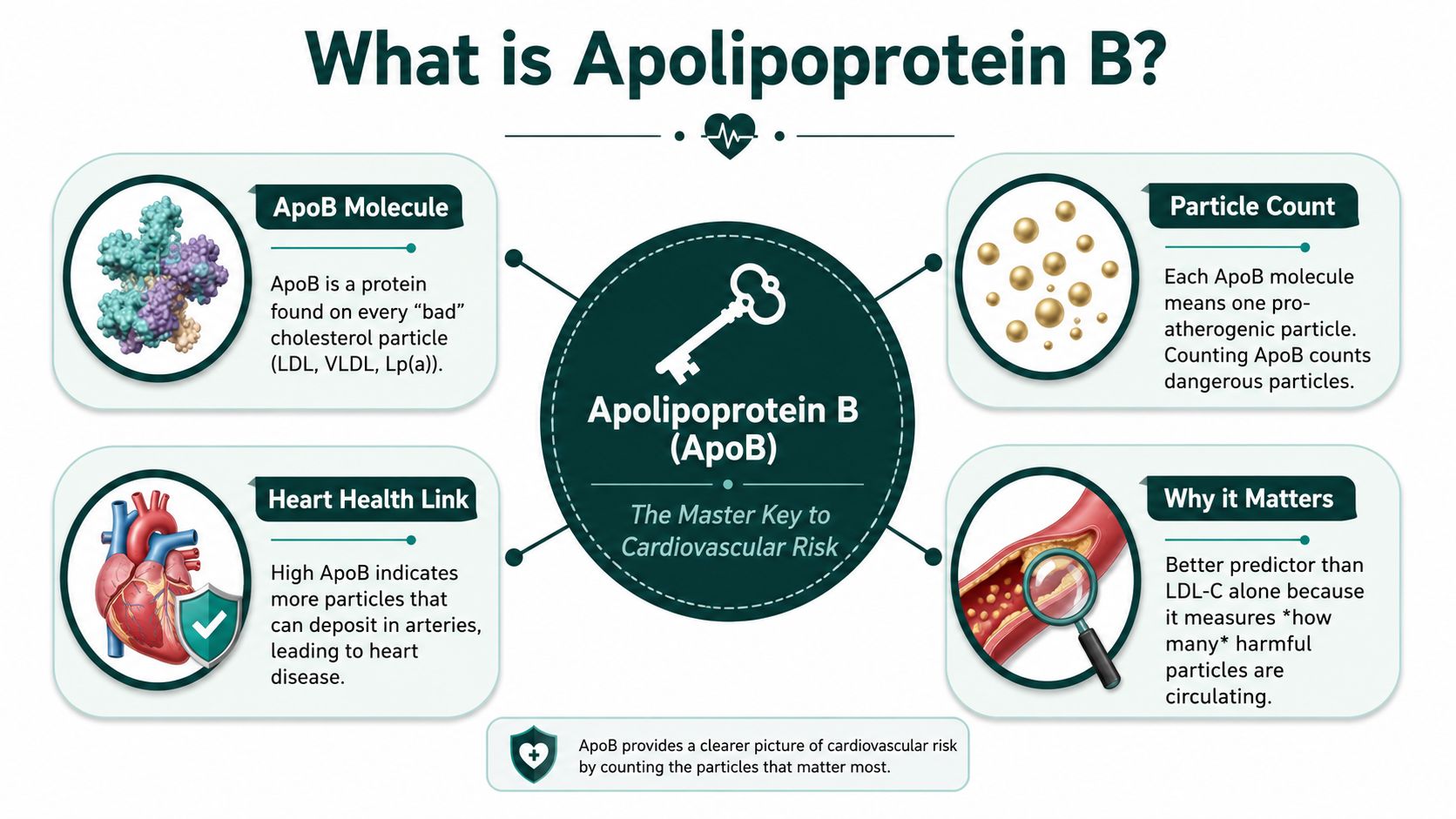
That's why ApoB is so useful. It answers a cleaner question. Not “How much cholesterol is being transported?” but “How many potentially plaque-forming particles are circulating right now?”
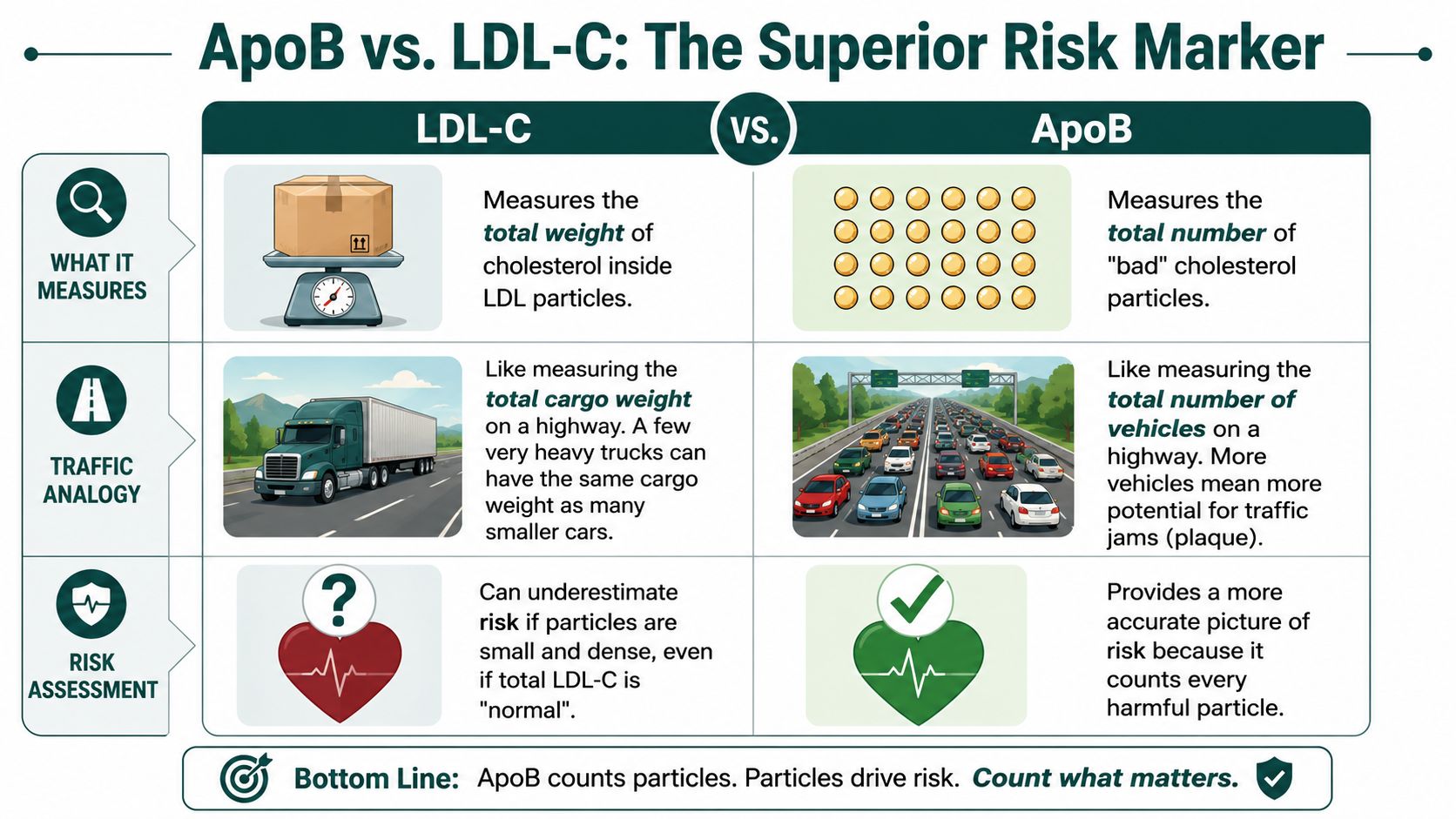
This is the mental model I use with patients and longevity-focused readers: if LDL-C tells you the total weight of cargo on the road, ApoB tells you how many vehicles are on the highway. A traffic jam is caused by the number of vehicles trying to squeeze through the same space. Your arteries face the same problem.
Why that changes risk assessment
ApoB also helps unify a scattered lipid story. Instead of tracking LDL alone and wondering how VLDL or Lp(a) fit in, ApoB captures the total burden of the major hepatic-derived atherogenic particles in one measurement.
That makes it especially helpful when the usual markers don't agree with each other.
If LDL-C looks controlled: ApoB can reveal residual particle risk.
If triglycerides are high: ApoB often adds clarity that standard cholesterol math misses.
If family history is concerning: ApoB can help verify whether LDL-related risk is addressed.
A related marker worth knowing is Apolipoprotein A-1, which reflects a different side of lipoprotein biology. But for counting the particles most tied to plaque formation, ApoB is the workhorse.
ApoB vs LDL-C The Superior Risk Marker
The easiest way to understand ApoB versus LDL-C is to stop thinking about cholesterol as a liquid and start thinking about transport.
Cargo weight versus traffic volume
LDL-C measures the cholesterol carried inside LDL particles. ApoB measures the number of particles themselves. Parsemus describes this cleanly: LDL-C reflects cholesterol cargo, while ApoB counts the actual atherogenic “trucks” because each LDL particle has one ApoB protein (Parsemus on why ApoB testing matters for heart health).
That difference isn't academic. It's operational.
A road with a few oversized trucks can carry the same total cargo as a road packed with smaller vans and cars. The second road is far more congested. In arteries, more particles mean more opportunities for retention in the vessel wall and more opportunity for plaque formation over time.
If you want a deeper look at the LDL side of the equation, a direct LDL cholesterol test can still be useful. But when LDL-C and clinical reality don't match, ApoB usually explains why.
Here's a useful explainer to watch before you go deeper:
Who benefits most from ApoB testing
Not everyone needs every advanced lipid test. But some groups benefit from ApoB more than others.
The people I worry most about are the ones with “acceptable” LDL-C plus obvious metabolic stress. That's where ApoB often changes the story.
Consider ApoB earlier if any of these apply:
Situation | Why ApoB helps |
|---|---|
High triglycerides | LDL-C may understate true atherogenic burden |
Metabolic syndrome | Particle number and cholesterol content often diverge |
Diabetes | Normal LDL-C can coexist with excess atherogenic particles |
Family history of heart disease | ApoB can sharpen risk assessment when standard lipids look ordinary |
LDL-C still matters. It's just not the best standalone marker when particle number and particle cholesterol no longer track together.
Interpreting Your ApoB Test Results
What if your LDL-C looks fine, but your artery risk is still higher than it appears?
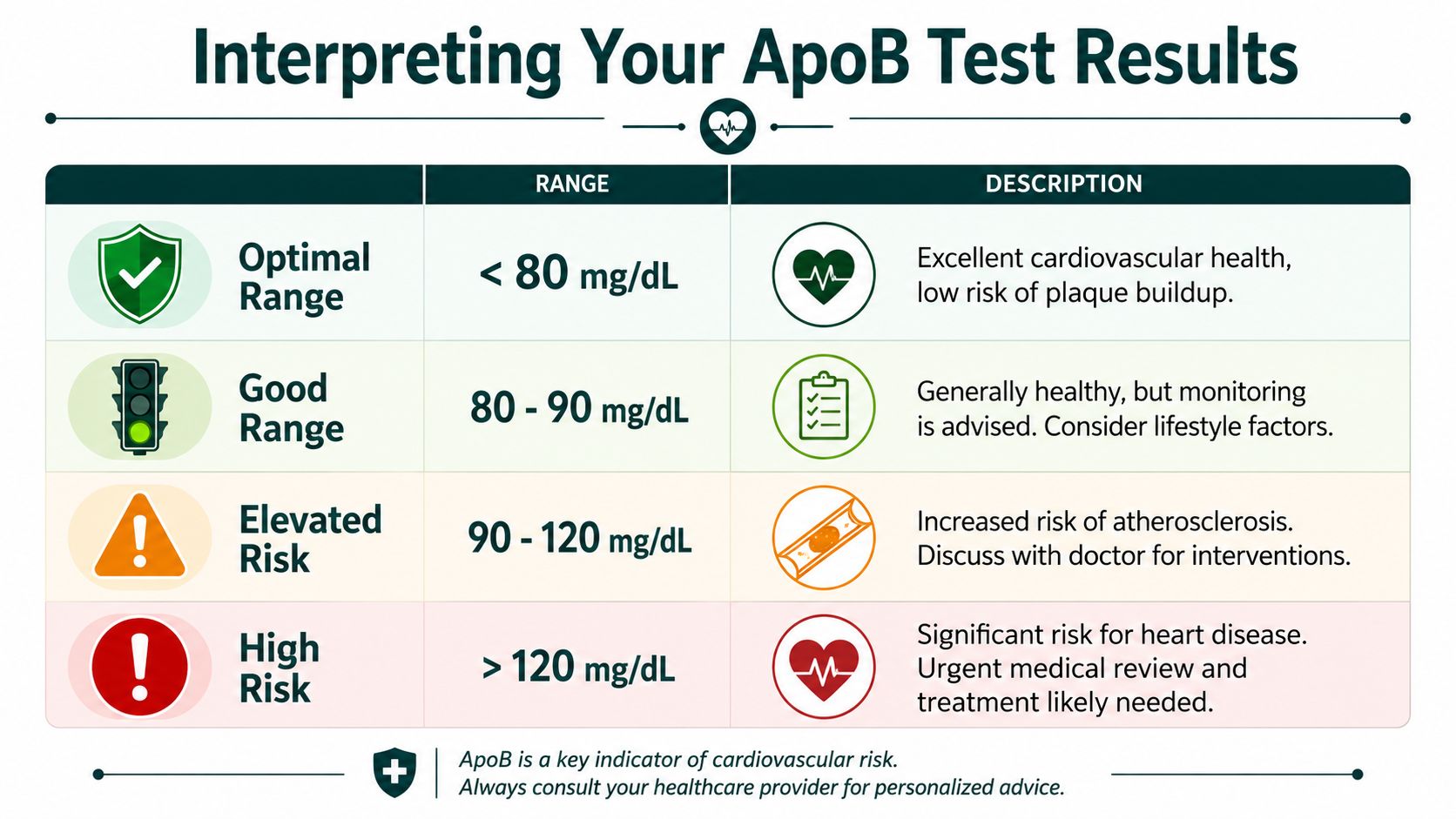
ApoB answers a simple question that a standard cholesterol panel can miss. How many atherogenic particles are present in circulation? LDL-C measures the cholesterol cargo. ApoB measures the number of particles carrying that cargo. In practice, particle count often tracks risk more closely, especially when triglycerides are high, insulin resistance is present, or LDL-C and real-world risk do not line up.
The ranges that matter
Use ApoB ranges as a traffic count, not just a lab value:
Less than 90 mg/dL is a reasonable target for people without known cardiovascular disease and with otherwise low risk.
90 to 129 mg/dL suggests increased particle burden and deserves context, especially if other markers or family history are concerning.
130 mg/dL or higher is high enough to take seriously. That result usually calls for a closer look at metabolic drivers, diet pattern, and whether medication should be part of the plan.
Clinical takeaway: ApoB above 130 mg/dL should not be dismissed because LDL-C looks “normal” or “adequately treated.”
For people with established cardiovascular disease, many lipid specialists aim lower. The 2022 ACC Expert Consensus Decision Pathway discusses intensifying therapy in very high-risk patients when ApoB remains high and supports a target of less than 70 mg/dL in that setting (ACC Expert Consensus on nonstatin therapy and ApoB thresholds).
A result in the middle range is where judgment matters most. An ApoB of 95 mg/dL may be acceptable in one person and too high in another. Age, blood pressure, coronary calcium, diabetes, smoking history, and family history all change how aggressive the plan should be.
When a result changes the plan
The most important ApoB result is often the one that contradicts the standard lipid panel.
A common pattern looks like this: LDL-C appears controlled, but ApoB stays high. That means the cholesterol per particle is low while the particle count remains high. You still have too many vehicles on the road, even if each one is carrying less cargo. That discrepancy is one of the most useful reasons to order ApoB in the first place.
If the picture is still unclear, pairing ApoB with advanced particle testing like an NMR Lipoprofile can help sort out whether particle number, size pattern, and triglyceride-rich lipoproteins are all pushing risk in the wrong direction.
Some readers also explore adjuncts like omega-3 products while working on their lipid plan. NexiHerb LLC on krill oil benefits gives a basic overview of that category, but the useful question is always the same. Did your ApoB improve after the change?
How to Lower High ApoB Levels
How do you lower ApoB when your standard cholesterol panel looks only mildly off, or even "fine"? You reduce the number of atherogenic particles in circulation and then verify that the count fell.
That last part matters. ApoB is a traffic count, not a rough impression of road conditions. If too many plaque-driving particles are still on the road, risk stays higher than the LDL-C line alone may suggest.
Start with the levers that change particle production at the liver level and improve insulin sensitivity. In practice, the highest-yield moves are usually not exotic.
Reduce refined carbohydrates and ultra-processed foods: This matters most when triglycerides are high, waist circumference is up, or insulin resistance is part of the picture. In that setting, lowering the glycemic load often improves the whole lipoprotein pattern, not just one number.
Adjust saturated fat based on your response: Some people can eat more saturated fat without a major ApoB rise. Others cannot. The useful approach is simple. Change intake, repeat labs, and use your own results instead of nutrition tribalism.
Train consistently: Aerobic exercise and resistance training both help. They improve metabolic health, support triglyceride control, and often make dietary changes work better.
Lose excess body fat if present: Even modest weight loss can reduce the liver's drive to produce atherogenic particles.
Supplements come up often. Omega-3 products may help in the right context, especially when triglycerides are part of the problem, but they are not a substitute for measurement. If you are comparing options, NexiHerb LLC on krill oil benefits offers a basic overview of that category. Ultimately, the question is whether your ApoB improved after the change.
Medication enters the plan when lifestyle work is not enough, baseline risk is high, or ApoB is clearly above a reasonable target for your situation. The National Lipid Association identifies ApoB above 130 mg/dL as a risk-enhancing finding that corresponds roughly to very high LDL particle burden in many patients (National Lipid Association scientific statement on lipid measurements in management of cardiovascular disease risk00126-0/fulltext)). For people with established cardiovascular disease or similarly high risk, clinicians often push much lower. As noted earlier, less than 70 mg/dL is a common aggressive target.
The main prescription tools are familiar:
Statins, which reduce hepatic cholesterol synthesis and lower ApoB-containing particles.
Ezetimibe, which reduces cholesterol absorption and is often the next add-on.
PCSK9 inhibitors, which can produce large particle-count reductions in higher-risk patients or in people who do not reach goal with other therapy.
The strategy is straightforward. Set a target that fits your risk. Make a focused change. Retest. If you do not know your baseline yet, a direct Apolipoprotein B blood test gives you the number that LDL-C can miss.
How to Test Your ApoB with Goodlabs
Goodlabs is a health platform that gives blood donors free clinical-grade lab panels (run at Quest or Labcorp), and offers the same panels at low cost to anyone who doesn't want to donate.
That matters for ApoB because this is exactly the kind of marker many motivated adults want, but standard care doesn't always prioritize. Access is usually the bottleneck, not interest.

You can order an Apolipoprotein B test directly if you want a clear read on particle number, or combine it with broader lipid markers if you're building a more complete cardiovascular picture. For people who donate blood through partner blood centers, Goodlabs can make advanced testing far more accessible. For non-donors, the à la carte route keeps things straightforward.
The benefit is clear. You stop relying on a single cholesterol estimate and start tracking a marker that reflects the particle burden driving plaque biology. That gives you a better basis for lifestyle changes, more informed discussions with your physician, and cleaner long-term monitoring.
Blood test results are informational and not a medical diagnosis. Talk to your physician about what your results mean for you.
FAQs What Is ApoB Cholesterol (2026)
Can ApoB be high if LDL is normal?
Yes. ApoB can be increased even when LDL-C looks normal, especially with high triglycerides, metabolic syndrome, or diabetes. That's why ApoB can reveal hidden particle risk.
Is ApoB better than LDL cholesterol?
Often yes for risk prediction. ApoB counts atherogenic particles directly, while LDL-C estimates cholesterol cargo. When those disagree, ApoB usually gives the clearer risk signal.
What is a good ApoB level?
For healthy low-risk adults, less than 90 mg/dL is acceptable. Levels from 90 to 129 mg/dL are borderline high, and more than 130 mg/dL is a high-risk range.
What ApoB level is too high?
More than 130 mg/dL is the key threshold. In primary prevention, that level is considered a risk-enhancing factor and should prompt a discussion about stronger intervention.
Does diet or exercise lower ApoB more?
It depends on what's driving it. Diet often has the biggest effect when triglycerides or insulin resistance are involved, while exercise helps by improving the broader metabolic picture.
If you want to move from “my cholesterol seems okay” to a more accurate view of particle-driven heart risk, Goodlabs makes that step practical. You can access clinical-grade ApoB testing through partner labs, get it free with qualifying blood donation in participating settings, or order it directly without a subscription.

Jake Kaiser
jakesjourney.co